Welcome back to the Daggerspell Reread and Review Series!
If you’re interested in learning more about Kate, me or this project, please take some time to read ‘Introducing: The Daggerspell Reread and Review Series, with Kate Elliott’, where we discuss our experience with Kerr’s work (None for me! Lots for Kate!), and our expectations for this reread/review series.
Last time around, we began reading Daggerspell and covered the first 196 pages. In that time, we were introduced to a feisty girl with an unlikely destiny, her worldweary father, an herbman who is much more than he seems, and a 400 year old tragedy that still resonates through their lives and the world of Deverry.
Kate explored the world of Deverry and unpacked why Katharine Kerr was able to create such a compelling and deeply lived-in fantasy world:
One of my favorite things about the Deverry series is that rather than being written in tight third person point of view, it is actually written in omniscient. The entire sequence is narrated by an outside narrator who has a specific point of view. She is clearly writing in the “future” of the world; that is, the narrator is a writer in Deverry writing historical fiction about her own world. Throughout the series she makes asides reminding the reader how a city has grown or that certain lands weren’t yet cultivated. Because of this there is a constant living sense of a world that is changing as places do. Both through the device of the narrator inserting brief explanatory reminders and through the use of the reincarnated lives by which the reader moves back and forth through time via the “past life” sequences and sees the same places in different centuries, Kerr depicts a slowly-changing culture and landscape. Deverry is never a static world.
So, return with us to the world of Deverry as we rejoin Jill, Cullyn and Nevyn as well as meet some new friends and enemies!
Spoilers Galore!
Read More »
I’m going to say some stuff about Young Adult fiction. Some of it’s going to be really wrong, but I’ll hedge by saying it’s my interpretation. Let’s try not to crucify me for it.
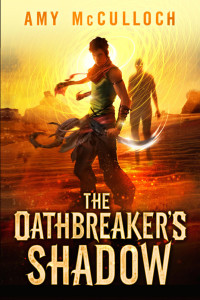
For me, what makes a book Young Adult isn’t the age of its protagonist, simplicity of story, or basic themes. Instead, it requires some didactic aspect. For example, Paolo Bacigalupi’s Shipbreaker isn’t just a fucked-up coming of age story, but a teaching tool for conceptualizing climate change, as well as refining mores for peer group interactions. I would argue the weakest part of the novel is its plot and protagonist, both of which feel cookie-cutter. What makes it successful for young readers is what it imparts. Thusly, I would argue, until I’m blue in the face, that Raymond Feist’s Riftwar Saga or David Edding’s Belgariad are not Young Adult. I would prefer to call them fiction for all ages. In other words, they tell a story that’s easy to understand for young readers, but does absolutely nothing to recommend it as something that ought to be targeted to them. I make this distinction because Amy McCulloch’s The Oathbreakers Shadow is a Young Adult novel, and a fine one at that. Read More »
Even if you put aside problematic assumptions of biological determinism, there’s still one thing I just can’t understand: why on earth would a fantasy world have to conform to the (supposed) rules of this one?
Lately there have been questions as to whether epic fantasy is inherently “conservative.” The term is sometimes specified in terms of political movement or ideological conservatism, but more broadly refers to the production and reproduction of social convention. I have serious doubts about the ideological bit, a point already well articulated by Liz Bourke. Unfortunately, I have little doubt about the rest—particularly in comparison to epic fantasy’s sibling genre, science fiction. But why is that, and does it really have to be that way?
I started thinking about these questions after reading excellent essays by Kameron Hurley and Foz Meadows on the historical precedent for women warriors in epic fantasy (as well as Django Wexler’s epic follow-up piece), and particularly after being drawn into a vigorous online discussion on that topic. The prevalent counter-argument, as I understand it, is this: for biological-evolutionary reasons (lesser upper body strength, necessity for the slow human reproductive process, greater empathy, etc.), women in our world are less likely to be soldiers; therefore, they should be less common as soldiers in fantasy worlds.
Huh? Read More »
Publisher: Tor Books -
Pages: 336 -
Buy: Book/eBook
“I am the Ruined Queen. Nothing of Erem can harm me. And we must drill, my soldiers. You must practice for war.”
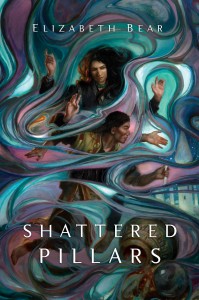
Range of Ghosts (REVIEW), the first volume of Elizabeth Bear’s fantasy trilogy, The Eternal Sky, was something of a revelation. At once it it managed to be full of life, of individuality, yet still reminiscent of the Fantasy genre’s adventurous roots in the ’80s and ’90s with Brooks, Feist and Eddings, and beyond that to the Sword & Sorcery of Leiber and Howard. Bear’s fictional world, deeply inspired by the steppes of Mongolia, the jungles of south-east Asia and the majestic Himalayans, was as heartbreakingly beautiful as it was fun and thoughtful. In 2013, there’s little else I ask for from a Fantasy novel than that it remains inclusive and progressive. When a novel has these qualities, and also manages to echo those early touchstone novels without feeling derivative, it’s like literary heaven. I had never read a novel by Bear before, and so was sheltered from preconceptions and expectations going into Range of Ghosts. Shattered Pillars, now, has the misfortune of being judged as the sequel to a book that I consider a beacon of hope for the future of epic fantasy. I once wrote about the dangers of reader expectation, yet I begin few novels with so high a level of expectation as I did when I opened Shattered Pillars. Read More »
With the upcoming release of Scott Lynch’s The Republic of Thieves, the long-anticipated third volume in his Gentlemen Bastards sequence, excitement among fans (especially creative ones) is higher than ever, to the point that Lynch recently released a statement regarding fan fiction in his universe. One of those fan projects is the video above, by filmmaker Milena Aijala. Aijala created title sequence for a hypothetical television series based on the series, and discusses the process on her blog. It’s a gorgeous piece of animation. Even cooler is Lynch’s excitement and endorsement of the project. There’s no television series in the works, but, dammit if this doesn’t set my mouth watering for one.