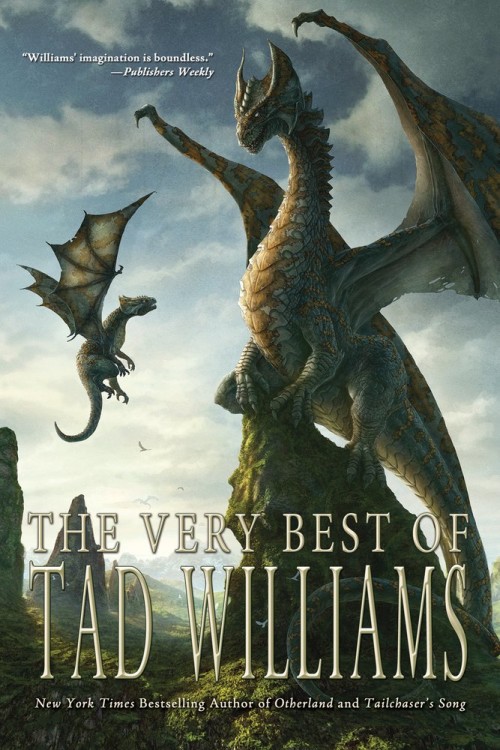

If you’re read this blog for any length of time, you’ll know that I’m something of an unabashed Tad Williams fanboy. He’s best known for his long (long, long, long) fiction, like Memory, Sorrow and Thorn or Otherland, multi-volume epics that would make most other authors weep at their length, but it’s often overlooked that some of his most finely crafted and powerful fiction is actually found among his shorter works. If this collection, coming from Tachyon, is, indeed, the ‘very best’ of his work, readers are in for a treat. The art on the cover is by Kerem Beyit, and is just lovely.
 I’m happy to introduce Foz Meadows, the newest contributing reviewer here at A Dribble of Ink. Foz joins Justin Landon as a contributing reviewer and will be publishing monthly reviews covering a wide range of novels. You might recognize Foz’s work from her own blog, Shattersnipe, her contributions to the Huffington Post, and her past writing here at A Dribble of Ink, including yesterday’s essay on escapism and privilege in Fantasy and Science Fiction. The Book Smugglers, in discussing their choices for the 2013 ‘Best Fan Writer’ Hugo award, described Foz as having ‘written some of the BEST blog posts and articles last year addressing sexism, racism, problematic narratives in Fandom and in YA, all in relation to SF,’ and I’m incredibly proud to bring a writer with such pedigree to A Dribble of Ink.
I was first introduced to Foz’s writing last year after recommendations from several other critics and blogging friends. Her reviews and commentary are sharp, insightful and intelligently engage with many of the important issues being discussed in the overall SFF discussion. For a proper introduction to Foz’s writing, I encourage you to check out her 2012 Year in Review. I feel that adding Foz to the team at A Dribble of Ink will continue to expand and add variety to the areas of coverage and topics of conversation covered, which, in this editor’s opinion, is a very good thing.
So, then, here’s to Foz.
When it comes to discussing the appeal of SFF and its various affiliated subgenres, escapism is an extremely relevant consideration. Given how strongly a pro-escapist perspective correlates with a pro-SFF perspective, and vice versa, the term has become a loaded one, such that a species of argumentative shorthand has developed around its usage. Thus: if escapism is a negative, then so too is the desire for escape, casting those who seek or enable it as naïve, childish daydreamers disconnected from reality. If escapism is a positive, then the pursuit of escape is a noble one, allowing us to transcend the limitations of what is in favour of embracing what could be. Though ostensibly a tried and true dichotomy, the term is ultimately inaccurate in this context: the escapist/realist schism is a false binary, not only because the presence of one element doesn’t preclude the presence of the other, but because both escapism and realism are subjectively realised states, not objective truths.
If escapism is a negative, then so too is the desire for escape, casting those who seek or enable it as naïve, childish daydreamers disconnected from reality.
Despite this fact, the fallacy remains a popular one, both at the external level (SFF is less realistic than straight fiction, and therefore less worthy) and the internal level (aspirational fantasy is less realistic than gritty fantasy, and therefore less worthy). Which isn’t to say such conversations are wholly without merit; indeed, a great deal of useful dialogue is spawned by them. It’s just that, at a fundamental level, there’s a tendency to hark back to an either/or that doesn’t exist, but to which we’ve historically ascribed inordinate importance. By definition, all fiction contains elements of escapism and realism, in that it both includes untruths and, being born of reality, is necessarily tethered to it – the only mitigating factor here is the ratio of truth to lies, and given the wildly divergent ends to which fiction can be turned, to say nothing of the myriad possible interpretations of truth, there’s hardly a rule of thumb for determining even that much with any degree of accuracy. The question of whether escapism constitutes a positive or negative force in SFF has nothing to do with its presence, therefore, but rather with the twofold matter what it is we’re escaping from and into. Read More »
Buy Speculative Fiction 2012: Book/eBook(Coming Soon)
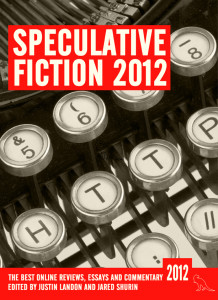
A couple of months ago, I announced that one of my essays was chosen to be included in a book called Speculative Fiction 2012, The Years Best Online Reviews, Essays and Commentary. The book is out now, and I’m all tingly with excitement. Justing Landon, co-editor of the anthology, describes the project:
This collection contains over fifty of the year’s best online essays and reviews, from Tansy Rayner Roberts on Supergirl to Lavie Tidhar on China Miéville to Aishwarya Subramanian on My Little Pony to Joe Abercrombie on, er, himself. It is a diverse collection of some of last year’s best and most interesting writing. We fully expect – and hope – it will cause discussion, debate and a bit of a ruckus.
The book also contains a foreword from Orbit author Mur Lafferty, an introduction from this year’s editors (Jared Shurin and myself) and an afterword from the 2013 editors, Ana Grilo and Thea James of The Booksmugglers. Not to mention the beautiful cover from the talented Sarah Anne Langton.
All proceeds from sales of this book are donated to Room to Read, supporting literacy and gender equality in education around the world.
My contribution to this collection is an essay/critique of A Dance with Dragons by George R.R. Martin, where I analyze how fervor and anticipation can be the enemy of objectivity and fair reviewing practices.
I am thrilled to be included in the anthology alongside other great fan writers such as Ana Grilo, Thea James, Paul Kincaid, Maureen Kincaid Speller, Jonathan McCalmont and Tansy Rayner Roberts. I mean, seriously, my essay comes directly after pieces by Abigail Nussbaum and Adam Roberts. Talk about humbling company. In addition to this, Speculative Fiction 2012 includes two other articles published on A Dribble of Ink: ‘Concerning Historical Authenticity in Fantasy, or Truth Forgives You Nothing’ by Daniel Abraham, and ‘Ma Vie en Zines’ by Chris Garcia. I hope you enjoy the book and, like I have, discover some new writers in the process.
Buy Speculative Fiction 2012: The best online reviews, essays and commentary (Volume 1): Book/eBook (coming soon)
Publisher: Tor Books -
Pages: 880 -
Buy: Book/eBook
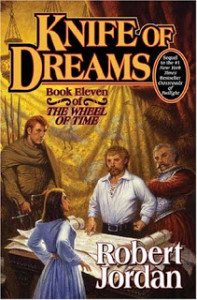
From what I’ve gathered, Knife of Dreams was lauded back in 2005-2006 as a sort of “return to form” for Jordan. The MMPB page count reached 860, so perhaps if “return to form” means writing a bunch of pages, then this book achieved that goal admirably. If “return to form” also means that the author continues to repeat too many descriptive details of his characters and having an over-reliance on “national” stereotypes to substitute for uniform substantive character development, then maybe Knife of Dreams accomplished this as well.
[A] slightly greater sense of urgency, whenever the characters did not stop to sip their peppermint-flavored tea.
But on the whole, this was a better reading experience than the previous two novels. There were some long-awaited (and long-delayed) subplot resolutions that take place here. There was a slightly greater sense of urgency, whenever the characters did not stop to sip their peppermint-flavored tea served on a silver service. And there was one romantic relationship that managed to outdo Stephanie Meyers’ travesties. In a world (again, plug in that late, great movie trailer guy’s voice) where virtually all relationships feel light as a feather and stiff as a board (those readers in their mid-30s to mid-40s might get that reference), the interplay between the mischievous Mat and his bride-to-be, the Seanchan Daughter of the Nine Moons, Tuon, is actually well done. When it seems some characters *cough*Rand*cough* fall in love (or have someone fall in love with him) at the drop of the hat, this budding romance was not as offensive to read, although there were a few times where it felt as though the relationship was taking place more due to “prophecy” influences than anything “natural.” Read More »