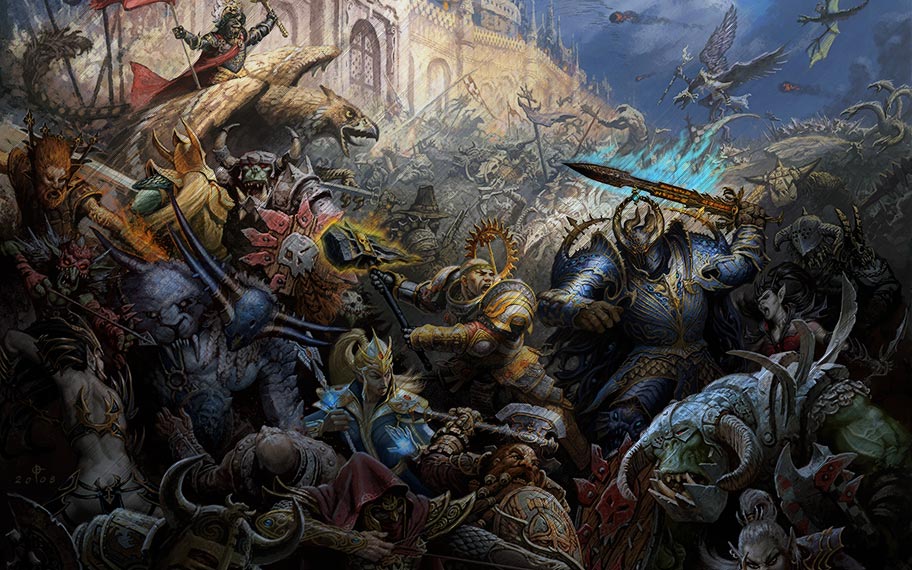
Starting with Tolkien, it’s become practically obligatory that the epic fantasy saga, somewhere around the middle of book three, feature an Epic Confrontation Between Good and Evil with a Cast of Thousands.
I am, I have to admit, a war buff. I read military histories for fun, the kind with fold-out maps covered in little colored arrows and notations like “Kollowrath (40,000)”. As I am also a fantasy novelist, the nature of war in fantasy fiction has always been fascinating to me.
And there is a lot of war in fantasy. Starting with Tolkien, it’s become practically obligatory that the epic fantasy saga, somewhere around the middle of book three, feature an Epic Confrontation Between Good and Evil with a Cast of Thousands. Various allies, painfully recruited over the course of the hero’s journey, turn up to lend a hand at the Final Battle. Various villains are dispatched, hapless orcs or equivalent humanoids are mowed down by the score, and just when things seem bleakest Evil is defeated forever. A beloved secondary character or two bites the dust, and someone gets to make a Heroic Sacrifice. Afterward, we may be treated to a scene where the hero roams a battlefield strewn with corpses, or visits the injured to bring home the horrors of combat. You know, war, right?
Back before I wrote fantasy myself, my wargamer friends and I used to snicker a bit at this. Most of the fantasy authors wouldn’t know a halberd from a half-pike, and their descriptions of battles were usually heavy on bold strokes and dramatic confrontations and light on tactics and the important of proper reconnaissance. I wouldn’t want to be a poor foot-slogger in either army, given the rate at which they tend to be chewed up by either the hero and his friends or some villain demonstrating the full extent of his power. Read More »
Publisher: Tor Books -
Pages: 846 -
Buy: Book/eBook
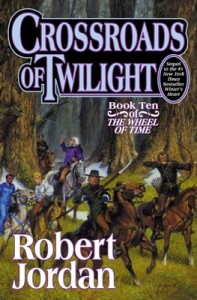
Over the years, Crossroads of Twilight has borne the dubious distinction of being considered the “worst” WoT book of them all. Even fans of the series tend to view it as containing mostly extraneous material that could and should have been included in the previous two volumes with no loss in narrative flow (if anything, narrative flow would have been sped up, these people would argue). This book is held in such low repute that back when I was a moderator for two of wotmania’s forums, there were people who kept urging me to “review” the book just to see how much fun I could have in ripping it apart. So I agreed to do so almost four years ago. Too bad this one clip is the one preserved piece of that epic parody walkthrough, as I did do a part with the infamous “Elayne bath scene” where I spliced quotes from that chapter with the opening scene of Modris Eksteins’ excellent World War I cultural history, Rites of Spring (the automobile graveyard, for those who are curious).
So I suppose I am at the point where those who’ve taken exception to my commentaries on the series are hoping that I’ll be so disgusted with the horrible prose, the mostly flat and dry characterizations, the execrable plotting, and glacial pace that I’d do a Roberto Duran and cry out, “No más, no más!” Read More »
According to The Verge, Disney is planning to release a new Star Wars film every summer for five years. This schedule will begin with Episode VII in 2015, VIII in 2017, and IX in 2019. Sandwiched between these releases will be standalone films, presumably starring some of the series’ more popular characters (Yoda, Han Solo and Boba Fett have all been rumoured.
Thoughts?
Publisher: Jo Fletcher Books UK -
Pages: 704 -
Buy: Book/eBook
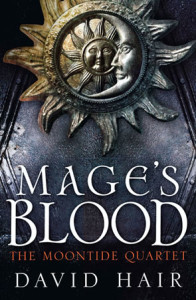
In a fantasy marketplace that has only recently seen a conclusion to Robert Jordan’s iconic Wheel of Time, and long suffering delays to George R.R Martin’s A Song of Ice and Fire, I’ve compiled a list of authors and series I can recommend in their place, which includes: Peter Brett’s Demon Cycle, Elizabeth Bear’s The Eternal Sky, Daniel Abraham’s The Dagger and the Coin, and Brent Weeks’s Lightbringer. That established, David Hair’s first adult novel, Mage’s Blood is one of the better epic fantasy series first instalments I’ve read in recent years.
It should be noted that when I refer to the term epic fantasy, I really mean it. Sweeping conflicts, clashes of cultures, political and personal entanglements, rich and in-depth magic, and mighty warriors dot the landscape. There’s even lavish descriptions of food,
…they ate a cold meal of dried meat and breads, washed down with a small flask of arak and some water, all from the wagon’s spoils. Tanuva Ankesharan’s best cooking could not match so wondrous a feast as this scavenged meal.
Written in limited third person from multiple points of views, Mage’s Blood does maintain some notion of good and evil. It walks a fine line though, often refusing to color individuals entirely one or the other. In that sense it’s quintessential modern epic fantasy, but couched in a very expected setting. Read More »
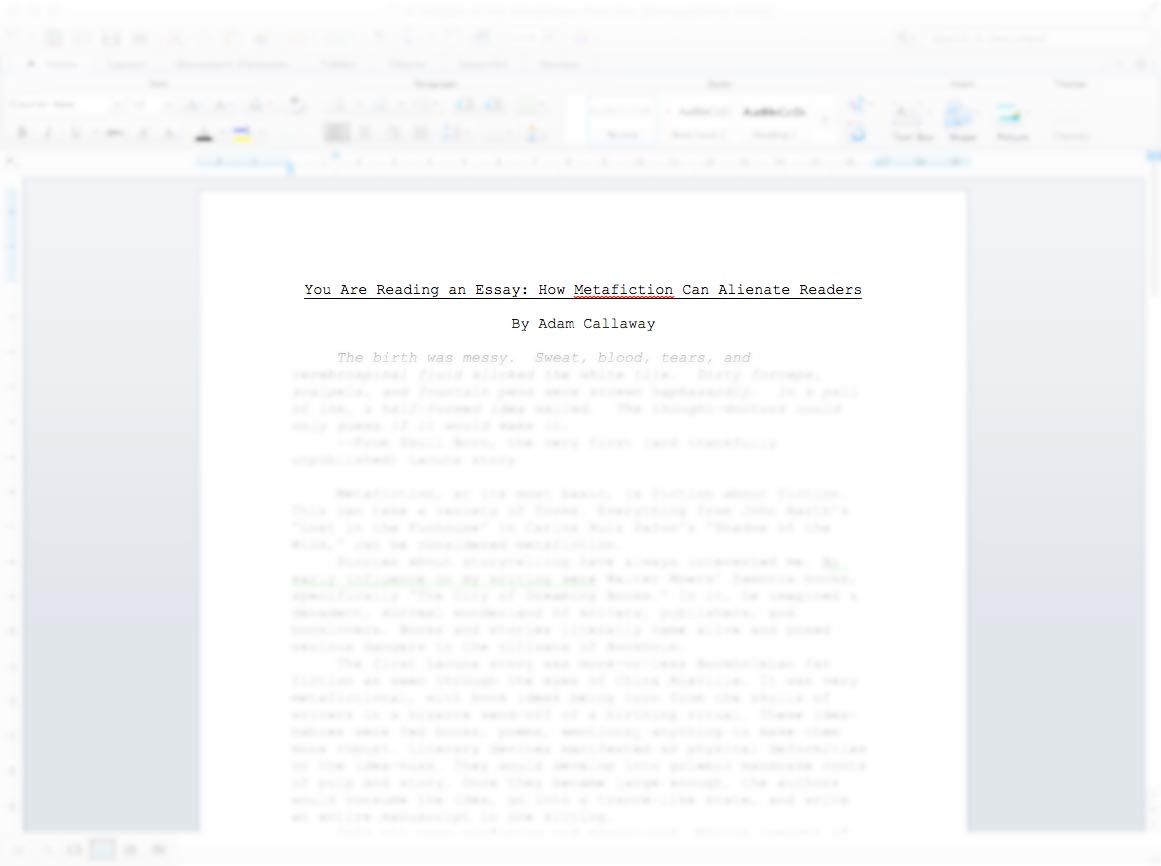
The birth was messy. Sweat, blood, tears, and cerebrospinal fluid slicked the white tile. Dirty forceps, scalpels, and fountain pens were strewn haphazardly. In a pail of ink, a half-formed idea wailed. The thought-doctors could only guess if it would make it.
–From Skull Born, the very first (and thankfully unpublished) Lacuna story
Metafiction, at its most basic, is fiction about fiction. This can take a variety of forms. Everything from John Barth’s Lost in the Funhouse to Carlos Ruiz Zafon’s Shadow of the Wind, can be considered metafiction.
Stories about storytelling have always interested me. An early influence on my writing were Walter Moers’ Zamonia books, specifically The City of Dreaming Books. In it, he imagined a decadent, surreal wonderland of writers, publishers, and booklovers. Books and stories literally came alive and posed serious dangers to the citizens of Bookholm.
The first Lacuna story was more-or-less Bookholmian fan fiction as seen through the eyes of China Mieville. It was very metafictional, with book ideas being torn from the skulls of writers in a bizarre send-off of a birthing ritual. These idea-babies were fed books, poems, emotions; anything to make them more robust. Literary devices manifested as physical deformities on the idea-husk. They would develop into golemic mandrake roots of pulp and story. Once they became large enough, the authors would consume the idea, go into a trance-like state, and write an entire manuscript in one sitting. Read More »