Publisher: Orbit Books -
Pages: 512 -
Buy: Book/eBook
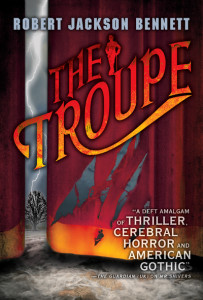
I admit, prior to reading The Troupe, I had no idea what vaudeville was all about. I had an idea in my head, based on implied fuzzy cultural memory, but it’s not something I’d ever taken a moment to actually look into. Having read Erin Morgenstern’s The Night Circus and paged through Mechanique: A Tale of the Circus Tresaulti by Genevieve Valentine, two circus-themed novels from 2011, I classified Bennett’s novel in my mind as another entrant in this newly popularized subgenre. Vaudville isn’t the same as a circus, but I was expecting a similar type of novel where the setting is as much a character as the people that populate it. The Troupe shattered those notions. Plot and character driven, set against a vaudville background, Bennett’s novel calls to mind the stylings of Neil Gaiman and lives up to the comparison.
Sixteen-year-old pianist George Carole has joined vaudeville to find Heironomo Silenus, the man he suspects to be his father. As he chases down Silenus’s troupe, he begins to understand that their performances are unique even for vaudeville and strange happenings follow in their wake. It’s not until after he joins them that George realizes the troupe isn’t simply touring, and Silenus is hiding a secret as old as time itself. Told in a tight third person voice, The Troupe follows George through his experience as a vaudeville act, a lost young man searching for direction, and a chess piece in an endless metaphysical war. Not surprisingly, the novel is divided into three parts that roughly correspond to each of those story arcs, although none are entirely resolved until the final pages. Read More »
 “Urban Fantasy” is a hot term these days. You hear it used to describe everything from Charlaine Harris’ Sookie Stackhouse books to Jim Butcher’s Dresden Files. It encompasses the work of authors from Patricia Briggs to Kim Harrison, from Ilona Andrews to Kevin Hearne. With such a diverse range of talent, the definition quickly loses meaning. There isn’t a whole lot that’s urban about the sleepy, small town of Bon Temps.
But that’s okay. Because urban fantasy has never been about urban settings. It’s about *contemporary* settings. It does a very simple thing: it takes the modern world, the one we live in every day, and ask the question, “What would this be like if magic were real?”
If the genre’s popularity is any indicator, that question has traction. Fantasy has, for much of its lifespan, been dominated by ancient and medieval settings. Many of the most enduring works in the genre, from Tolkien to Brooks to Feist, are set in pre-gunpowder, pre-industrial revolution worlds. But readers don’t ride to work on horses, hunt deer for dinner, or carry a sword to fend off the occasional Orc raid. Contemporary fantasy’s popularity suggests that many readers like to dream about the impossible right in their own backyard.
And here’s where you can run into trouble writing contemporary stories. The same thing that makes a contemporary setting resonate so strongly with the reader may also piss them off: Ownership. Read More »
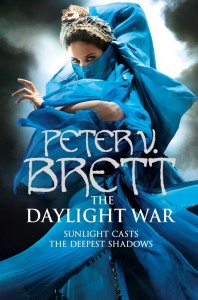
Every Friday, Suvudu publishes a 50 (or so) page excerpt for one of their novels. Often, it’s an older novel, maybe the first volume of a series with a new book around the corner, or just the works of a classic author looking to expand their audience. It’s a neat feature, even if I don’t use it much myself. Every once in a while, however, they really knock things out of the park for fans of their authors. This time, they’ve released an early look at The Daylight War by Peter V. Brett, one of the Fantasy community’s most anticipated Spring releases.
Peter V. Brett’s Demon Cycle Series is the tale of humanity’s last stand against demonkind—and so it’s one of the most heart-stoppingly action-packed fantasy series I’ve ever read, with epic warfare, badass heroes, and plenty of awesome demon carnage. But the Demon Cycle is more than a thrill ride: Peter’s true secret weapon is his unforgettable characters. This excerpt from The Daylight War takes us deep into the origin story of Peter’s most fascinating and mysterious creation, Inevera the demon priestess. While The Daylight War delivers all the propulsive storytelling and pulse-pounding ation that’s made the Demon Cycle a blockbuster series, Inevera’s story is the book’s dark and secret heart.
Despite my reservations for the second volume in Brett’s Demon Cycle, I loved The Warded Man, and look forward to dipping my toes back into his world (to see how much he’s learned as a writer, as much as to reconvene with his characters, if I’m being honest.) Early buzz on The Daylight War suggests that it might be the best of Brett’s books so far, and I don’t say that lightly. So, fans, enjoy, and read an excerpt from The Daylight War by Peter V. Brett.
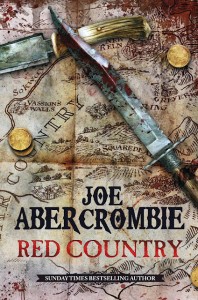
Map by Dave Senior and Daggers by Didier Graffetaption
From the horse’s mouth to your ears:
I’ve got a contract for three more books in the First Law world, and those will be a trilogy, and I have some rough ideas about what the content and characters might be.
Yippee. But, we already knew that, didn’t we? For about two years. In a recent ‘guest post’ (to use the term loosely, it was more of an open letter to his fans on his publisher’s website), Abercrombie addressed this trilogy, and some of the complications he’s been facing in writing it. He further describes those ideas about content and characters for the trilogy as ‘very rough.’ With his previous projects, Abercrombie has finished each book with a good idea of what was coming next, so that he was well into the writing of it by the time his previous book was published. He explains, however, that Red Country was a difficult book to write.
He says,
Red Country was pretty draining. Not that I’m not totally delighted with the results because, you know, brilliant book and all that, but I found it hard work. Felt burned out at times. Felt like I was having to reach a long way for new ideas, new ways of doing things. It was not, at all times, a joyous process. So now seems a good time to take a break, do some reading, do some thinking, recharge the creative batteries.
Read More »

Pop Culture is full of phenomena. These phenomena capture the imagination of millions, and dominate talk around water coolers, Internet forums, Twitter and pub tables. Many factors lead to the formulation of such zeitgeists, such as focussed marketing, fresh storytelling that taps into flash-in-the-pan societal fears and interests, a bold take on traditional concepts, or, well, because they’re just damn easy and accessible. Such phenomena, by their very nature, come and go. They sweep through fans like a fever, and burn out just as quickly.
Lost was a cultural phenomenon… until the second and third seasons when the show-runners jumped the trails and lost control of their script. As I write this, “Gangnam Style” is sweeping America, Europe and the rest of the world, yet Psy, the Korean musician behind the hit, will likely never release another song which significantly impacts Western pop music.
There are phenomena like Pokemon: a weird, complex Japanese videogame and television series that captured the attention of children fifteen years ago and still hasn’t let go. Each new iteration of the video game series sells millions of copies, and the animated series is still running today. Most famously, there is also J.K. Rowling’s Harry Potter. When it first rose to wide prominence at the turn of this century, it was easy to dismiss Rowling’s work as a fad. But then it kept on going, and going, and going. Harry Potter and his friends Hermione Granger and Ron Weasley are now literary staples on the same level as Bilbo Baggins and the Pevensies.
Read More »