Posts Tagged: Review

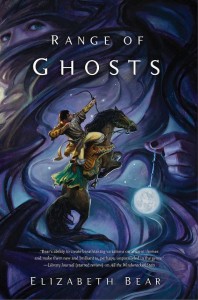
Range of Ghosts by Elizabeth Bear

Publisher: Tor Books - Pages: 336 - Buy: Book/eBook
Range of Ghosts by Elizabeth Bear

Epic Fantasy is in the midst of something of an identity crisis. See, mainstream readers love to lap up recognizable tales of valourous kitchen boys, big magic, elves, dwarves and warring kingdoms. Such novels sell like hotcakes, and publishing companies love them. And why not? We all grew up on it, didn’t we? Terry Brooks, Raymond E. Feist, Barbara Hambly, or Tad Williams — they built worlds unlike any we’d ever seen before. On the other hand, there are more critical fans who, perhaps, associate their love of Fantasy with an ever-expanding need to find works that push the boundaries of imagination, explore the issues of culture, politics and gender in our world through the lens of an imaginary universe where rules are different, where freedom and fairness might exist.

There have always been authors who push against these boundaries set on the subgenre by its legion of fans. Early in her career, Robin Hobb released the Farseer trilogy, which took the foundations built upon by Tad Williams and Robert Jordan and refined and redefined them, crafting a world and genre that was familiar, but spun the tropes (kitchen-boy-turns-king becomes bastard-prince-becomes-assassin; not an elf or dwarf in sight and conflicts that are cultural, rather than racial) in new, interesting ways. Going even further back, Terry Brooks revitalized Fantasy from its post-Tolkien doldrums by effectively re-telling modern Fantasy’s greatest tale, but, alongside him was Stephen Donaldson and his The Chronicles of Thomas Covenant, the Unbeliever trilogy, a work with similar roots to Brooks’ The Sword of Shannara, but an entirely different interpretation and subversion of genre tropes. While pushing the genre forward isn’t entirely anathema to commercial success, it’s a rare few authors who have managed to capture lightning in a bottle with their daring works. Read More »
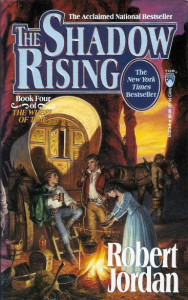
The Shadow Rising by Robert Jordan

Publisher: Tor Books - Pages: 1008 - Buy: Book/eBook

In my last commentary, I commented about how one of the major reasons why I decided to do these re-reading projects was to learn more about myself as a reader and critic and to explore how my takes on various novels had changed over an intervening period of several years. For the first three Wheel of Time novels, my overall attitude had shifted only slightly. I still liked the first book, The Eye of the World, better than the second and third volumes, The Great Hunt and The Dragon Reborn. What I liked and why, however, had changed, sometimes drastically.

In particular, I found even the first three volumes to contain several annoying features. Among them, average, pedestrian prose, laziness in using quirks and invented stereotypes to describe characters and imagined cultures, and the beginnings of what author/critic Adam Roberts has referred to as “decor-porn.” Despite these annoying narrative features, I was able to enjoy those three volumes as long as I focused on viewing the books as a sort of quest narrative. If I had devoted more time to looking at the numerous “prophecies” and their ilk and tried to predict as-yet-untold events rather than concentrating on the story at hand, I suspect I would have grown bored quicker than I have. Read More »

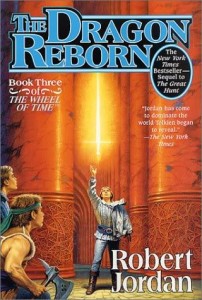
The Dragon Reborn by Robert Jordan

Publisher: Tor Books - Pages: 704 - Buy: Book/eBook

One of the interesting things about this re-reading project of mine is discovering how I have changed as a fiction reader and, to a lesser extent, as a critic over the course of the past decade or so. As I remarked in my reviews of The Eye of the World and The Great Hunt, some of the elements that used to irritate me greatly were not as noticeable this time around, while other plot and characterization issues that I had dismissed during my first few reads of the series seemed to be more visible during this current re-read.

One thing that I focused on as soon as I began this re-read was the notion that this massive twelve-volume series (and counting) could be divided into distinct narrative arcs. In particular, I was curious to see if the first three volumes might differ in their plot structures and presentation from succeeding volumes. To an extent, there is indeed an interesting interplay between these three early novels that I have not seen during my current re-reading of the fourth volume.

Seeing [Rand] struggle to fight for control of his double-edged magical powers through his actions and failures […] was a refreshing change.

The Dragon Reborn opens several weeks, if not months, after the Battle of Toman Head that concluded The Great Hunt. Rand al’Thor, who has now successfully fought off the EVIL Ba’alzamon, the presumed Dark One in this Manichean-style cosmos, twice in the previous two volumes, is still struggling to deal with the revelations of the past year. Born gifted/cursed with awesome power that is tainted for males, Rand constantly frets in the early chapters about his “destiny” as the reincarnated Dragon Reborn and the belief that the apocalyptic Last Battle was drawing nigh. Although Jordan continues to lapse into lengthy descriptive passages that fail to let the characters illustrate their conflicts through their actions, I found myself being more drawn into Rand’s plight that I ever remembered being when I last read this book a decade ago. Seeing him struggle to fight for control of his double-edged magical powers through his actions and failures more than through his internal monologues was a refreshing change. Read More »

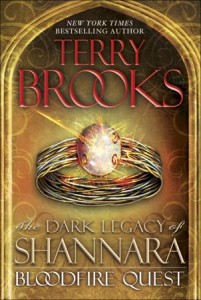
Bloodfire Quest by Terry Brooks

Publisher: Del Rey - Pages: 368 - Buy: Book/eBook
Bloodfire Quest by Terry Brooks

In recent years, I’ve reviewed several novels by Terry Brooks, most of which I walked away from with disappointment and uncomfortable acceptance. Slowly, with each new release, I was beginning to understand that Brooks, an idol of my adolesence, just wasn’t the same author I grew up with. This isn’t a comment on his skill, or his prose ability, necessarily, but rather an observation about the stories he now chooses to tell. His early novels were doorstops and told a complete story arc from beginning to end. After his third novel, however, he began to split these novels into ‘trilogies,’ and release them on a yearly basis. There’s little less satisfying than picking up a new book from a favourite author and being left hanging, asked to wait politely for a year and then pony up another $25 to continue with the fun. Whether it was marketing malfeasance on the part of his publisher, or a conscious decision by Brooks, excitement was slowly replaced by… not apathy, exactly, but controlled optimism. Brooks was on a treadmill.

Then I read Wards of Faerie (REVIEW), the first volume in his The Dark Legacy of Shannara trilogy, and, like the clouds parting over the Battle of Pelennor Fields, I was suddenly heartened and reminded of why I first fell in love with Brooks’ novels as a teenager. Read More »

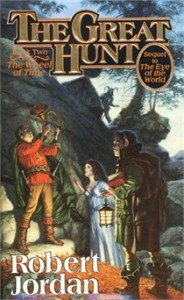
The Great Hunt by Robert Jordan

Publisher: Tor Books - Pages: 705 - Buy: Book/eBook

Last week, I prefaced my commentary-like review of the first Wheel of Time book, The Eye of the World, with explanations as to why I was embarking on this re-read project after a decade-long break. It would be redundant to repeat all of that, so if you have not yet read the original review, I suggest you start with that before reading this second, shorter review of the second volume in the series, The Great Hunt.

When I first read this book back in November 1997, I found it to be a major step backwards from the first novel. In the few re-reads I did between then and the autumn of 2000, I recall that my opinion of the book (and the third volume, The Dragon Reborn) did not improve at all. But what impressions would I take after reading it nearly ten years later?

Several of the same problems that I felt plagued the first volume were pretty much repeated in this second volume[, yet] despite this, in some ways, this story was more enjoyable than I had remembered it being a decade ago.

On the whole, I would still argue that The Great Hunt was a less enjoyable reading experience than was The Eye of the World. Several of the same problems that I felt plagued the first volume (too lengthy personal descriptions of minor characters, an uneven pace to the plot(s), the thin characterizations of the major characters and even more importantly, the enemies, the rather pedestrian prose) were pretty much repeated in this second volume, with a few curious additions. Yet despite this, in some ways, this story was more enjoyable than I had remembered it being a decade ago.

The story picks up roughly one month after the conclusion to the first novel. Rand al’Thor, one of three adolescent males from the backwater village of Emond’s Field, has discovered that he can touch the magical, tainted male side to the magical One Power (which runs the universe, in a way that I wonder might be analogous to the “dark matter” that makes up most of the universe’s mass). Furthermore, he may be the reincarnated soul of the dreaded Dragon Reborn, who in madness helped destroy civilization after a ten-year battle with the forces of evil. Rand is the hero (villain?) of prophecy, a mantle he does not want and makes quite clear, in both internal monologues and in conversations with characters, on numerous times. As I was reading this, I kept wondering to myself if perhaps the author went a little overboard with utilizing repetitive comments to reinforce the centrality of Rand’s conflict. It felt a bit forced at times to me and I cannot help but to speculate how differently (and perhaps, how much more powerfully) a reduction in the times Rand (and to a lesser extent, the other character and their own personal crosses which they bear quite vociferously) has to put voice to his conflicted thoughts. Read More »