Publisher: Orbit Books -
Pages: 688 -
Buy: Book/eBook
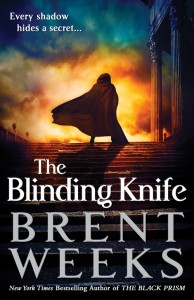
My first exposure to Brent Weeks wasn’t through his fiction, though his first series, the Night Angel Trilogy, was popular among other bloggers and readers like myself. Instead, I was first exposed to Weeks through Twitter (@BrentWeeks). At some point long forgotten, Weeks and I began following each other. Me, a blogger with the potential to promote his books; him, an up-and-coming Fantasy writer who had the gall to not only finish a chunky Fantasy series in three books, but publish the whole trilogy over the course of only two months. I found Weeks to be funny and generous, and a passionate fan of Fantasy, with many similar authors littering the root of his passion and mine. Most pointedly, perhaps, was Terry Brooks, one of the forefathers of modern Fantasy.
So when his next trilogy was announced, a trilogy entirely unrelated to his previous work, I decided that I’d jump in there, not just out of curiosity, but because I now considered Weeks a friend, if one connected only by the thin threads of Twitter and Facebook. My reaction to the novel was somewhat mixed. For all its successes — a likeable set of protagonists, an interesting take on typical Epic Fantasy worldbuilding, a fresh magic system — it was littered with problems — clunky exposition, an overreliance on the reader being invested in a complicated magic system — and I finished the novel feeling somewhat perplexed about my opinions. I couldn’t even be sure whether I enjoyed it or not, or whether I was interested in reading further in the series. Instead of reviewing the novel, I put it aside and just sort of let it be. Read More »
Publisher: Orbit -
Pages: 69 -
Buy: Book/eBook
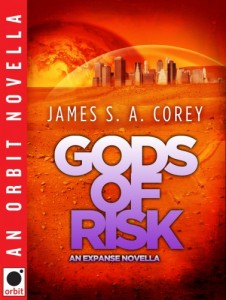
In support of the Expanse trilogy, James S.A. Corey, a pen-name for authors Daniel Abraham and Ty Franck, has been publishing a series of novellas set in the same universe (or, perhaps a more apt term would be solar system… get it?) as their popular inter-solar series, which began with 2011’s Hugo-nominated Leviathan Wakes (REVIEW), and was joined by 2012’s Caliban’s War, to be concluded in 2013 with Abaddon’s Gate, ‘Gods of Risk’ is the second of these novellas.
Though ‘Gods of Risk’ is set during the same time period as the Expanse trilogy, and featuring cameos by both characters and conflicts from the mainline novels, knowledge of the series in unnecessary. ‘Gods of Risk’ is an intimate story about a young martian (meaning, ‘born on mars,’ not ‘alien from mars’) man, Daniel Draper, a brilliant, but somewhat troubled student and drug manufacturer. The obvious comparison here is to television’s Breaking Bad, though Daniel’s insertion into the drug dealing community isn’t the result of desperation or need, but through social pressures and because, well, as a top-level chemistry student, he’s good at it and has access to the materials, making him an easy and obvious target for Hutch, a volatile drug dealer and tentative friend. Read More »
Publisher: Orbit Books -
Pages: 448 -
Buy: Book/eBook
The Hundred Thousand Kingdoms, N.K. Jemisin’s Hugo nominated debut, was one of the first novels I reviewed, at which time I said:
Jemisin presents a style that is uniquely intimate. I often felt like a voyeur lurking on the outskirts of something I shouldn’t be seeing. It is beautifully written and brims with emotion.
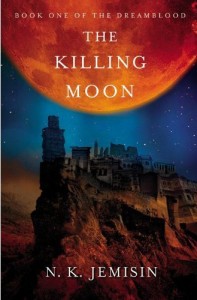
While I haven’t managed to read the subsequent two volumes in the Inheritance Trilogy, the outstanding nature of the first novel put The Killing Moon on my radar as soon as it was announced for 2012 release.
To anyone paying attention to genre scuttlebutt, it’s common knowledge that Jemisin is one of the more outspoken proponents of bringing new points of view to the fantasy lexicon. Whether that means non-western cultures, strong female characters, or more challenging narrative structures, she’s practiced what she preaches. In The Killing Moon the focus is more on the first two, eschewing the more complex narratives of her past work. The result is a plot oriented novel that will appeal to traditional fans of high fantasy as well as those tired of reading recycled characters and worlds. Read More »
King of Thorns
By Mark Lawrence
Hardcover
Pages: 464 pages
Publisher: Ace Hardcover
Release Date: 08/02/12
ISBN: 1937007472
Excerpt
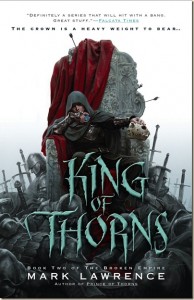
Prince of Thorns, Mark Lawrence’s 2011 debut novel, was not well received in all corners, occasionally offending reader sensibilities. Jorg, the protagonist and narrator throughout the series, is a self interested often bloodthirsty teenager who’s ruled equally by his emotions and lack thereof. Those hoping for a redemptive tale, or an ultimately apologetic tone from the author, found themselves woefully bereft. Deeply disturbing, and written with a haunting elegance, I called it the best fantasy debut of 2011.
Jorg, no longer a wandering prince in search of revenge, has taken a throne. Not his father’s or the Empire’s, but it’s a start. The path he carved has made him visible to those who share his lust for power, and now a six nation army marches toward his gates, led by a man far more suited to rule than he. An honorable man would lay down his sword and join the fledgling Empire in peace, leaving his kingdom whole and his people alive. That doesn’t sound like Jorg, does it?
Read More »
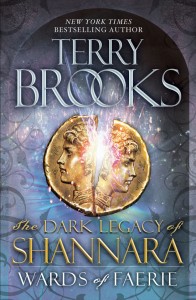
Wards of Faerie
by Terry Brooks
Hardcover
Pages: 384 pages
Publisher: Del Rey
Release Date: August 21, 2012
ISBN-10: 0345523474
Buy: Book/eBook
In the interest of full disclosure, I’m a moderator at the Official Terry Brooks Forums, a role which I take seriously and indicates my level of fandom for Brooks, but which has not coloured the following review.
In my review of Bearers of the Black Staff, the first volume of Brooks’ The Legends of Shannara duology, his most recent published work, I wrote:
[T]he real meat of Bearers of the Black Staff is in the familiar elements that begin to rear their heads. The Trolls, a race that’s played a maligned roll in many of Brooks other novels, are the stars of the show here, and much of their history is revealed to the reader, for the first time in the series. Their origin story, involving characters from The Genesis of Shannara is heavy-handed and would have been better left hinted at, but this is something Brooks fans should be used to by now. Astute readers will also begin piecing together hints of the Knights of the Word and their eventual transformation into the Druids that manipulate the world in later Shannara novels.
Ultimately, though, these familiar elements are also the novel’s (and Brooks’) weakest link. Terry Brooks has a vocabulary that he’s built up through his career. Not a vocabulary in the sense that you’d find it in a dictionary (though his prose isn’t exactly a bastion of variety, it’s serviceable and easy to read), but rather in elements, archetypes and plot devices that he uses to construct his stories. There’s next to nothing in Bearers of the Black Staff that we haven’t seen before in any of Brooks’ previous novel.
This dissatisfaction extended into the sequel, The Measure of Magic, and grew, leaving me with a bitter taste in my mouth as a longtime Shannara fan. I didn’t review The Measure of Magic, for fear of just repeating the exact same points I made in the first, with only a small measure of irony. Fast forward a year and I approached the release of Wards of Faerie with no little amount of trepidation. Since Brooks concluded The Voyage of the Jerle Shannara 10 years ago, with the exception of Armageddon’s Children, I felt disappointment with each of his novels, from mild to severe. Where was the Brooks I fell in love with as a boy, first discovering Fantasy? Was he gone? Or was I simply grown up, better read and unable to appreciate the type of fiction that Brooks writes? Read More »