Posts Tagged: Review

The Tiger's Wife by Tea Obreht

The Tiger’s Wife

By Tea Obreht
Trade Paperback
Pages: 368 pages
Publisher: Random House
Release Date: 01/11/11
ISBN: 0385343841

EXCERPT

The forty days of the soul begin on the morning after death. That first night, before its forty days begin, the soul lies still against sweated-on pillows and watches the living fold the hands and close the eyes, choke the room with smoke and silence to keep the new soul from the doors and the windows and the cracks in the floor so that it does not run out of the house like a river. The living know that, at daybreak, the soul will leave them and make its way to the places of its past — the schools and dormitories of its youth, army barracks and tenements, houses razed to the ground and rebuilt, places that recall love and guilt, difficulties and unbridled happiness, optimism and ecstasy, memories of grace meaningless to anyone else — and sometimes this journey will carry it so far for so long that it will forget to come back. For this reason, the living bring their own rituals to a standstill: to welcome the newly loosed spirit, the living will not clean, will not wash or tidy, will not remove the soul’s belongings for forty days, hoping that sentiment and longing will bring it home again, encourage it to return with a message, with a sign, or with forgiveness.

As a book reviewer, I’ve read many novels that were easy to write about, easy to critique or praise because they’re definable and have recognizable strengths and weaknesses. I’ve read several novels that I enjoyed so little that I felt the reviewing them would add little to the overall genre discussion beyond some shit slinging. I’d sit at my keyboard, trying to formulate a balanced, constructive argument for and against the work, and stumble again and again. And then there are novels on the knife’s edge of perfection, that are so joyous and heartrending that to speculate on them, no matter how effusively, would be to mar their beauty. Stardust by Neil Gaiman is one such novel for me. The Tiger’s Wife is another. There’s magic in this novel and I recommend it with every ounce of my passion for literature.

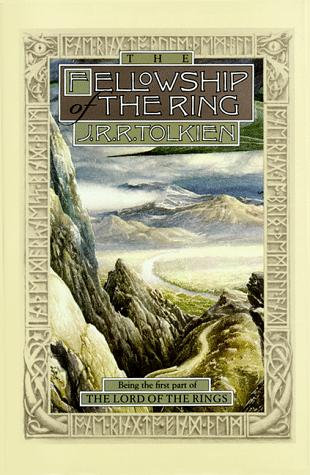
THE FELLOWSHIP OF THE RING by JRR TolkienWell, isn’t this wonderful?

Seventeen years ago there appeared, without any fanfare, a book called “The Hobbit” which, in my opinion, is one of the best children’s stories of this century. In “The Fellowship of the Ring,” which is the first volume of a trilogy, J. R. R. Tolkien continues the imaginative history of the imaginary world to which he introduced us in his earlier book but in a manner suited to adults, to those, that is, between the ages of 12 and 70. For anyone who likes the genre to which it belongs, the Heroic Quest, I cannot imagine a more wonderful Christmas present. All Quests are concerned with some numinous Object, the Waters of Life, the Grail, buried treasure etc.; normally this is a good Object which it is the Hero’s task to find or to rescue from the Enemy, but the Ring of Mr. Tolkien’s story was made by the Enemy and is so dangerous that even the good cannot use it without being corrupted.

The New York Times, a long-running and respected newspaper (that, you know, shapes the book industry with its list of bestselling books), has dug out and posted the 1954 review of J.R.R. Tolkien’s The Fellowship of the Ring, the first volume of his legendary Lord of the Rings.

There’s a fair bit of space devoted to simply retreading over the plot, which is mildly amusing now that Tolkien’s ideas and archetypes are now so staid and need no explanation in this day and age.

In addition to the Hobbits, there are Elves who are wise and good, Dwarves who are skillful and good on the whole, and Men, some warriors, some wizards, who are good or bad. The present incarnation of the Enemy is Sauron, Lord of Barad-Dur, the Dark Tower in the Land of Mordor. Assisting him are the Orcs, wolves and other horrid creatures and, of course, such men as his power attracts or overawes. Landscape, climate and atmosphere are northern, reminiscent of the Icelandic sagas.

The Dwarves are skillful? Orcs and horrid creatures fighting on the side of the evil lord? Oh my! It’s interesting to see that the author of the review picked up on Tolkien’s regard for Iceland and its myths, something that anyone who’s familiar with Tolkien will know influenced him significantly. As a hivemind, we Fantasy fans always like to point to Toklien as the prototype for creating a faux-medieval European Fantasy world, so it’s curious to see that this wasn’t an immediate distinction upon the publication of the novel.

Also catching my eye:

Lastly, if one is to take a tale of this kind seriously, one must feel that, however superficially unlike the world we live in its characters and events may be, it nevertheless holds up the mirror to the only nature we know, our own; in this, too, Mr. Tolkien has succeeded superbly, and what happened in the year of the Shire 1418 in the Third Age of Middle Earth is not only fascinating in A. D. 1954 but also a warning and an inspiration. No fiction I have read in the last five years has given me more joy than “The Fellowship of the Ring.”

A high-falutin’ newspaper that recognizes one of the main strengths of Fantasy literature? Say it ain’t so! If only the ‘literary’ critics in the 21st century were so perceptive. Thank goodness for the Lev Grossmans of the world.

The whole review is worth reading and a fun way to re-acquaint with a genre classic.

Ready Player One by Ernest Cline

Ready Player One

By Ernest Cline
Hardcover
Pages: 384 pages
Publisher: Crown
Release Date: 16/08/11
ISBN: 030788743X

EXCERPT

Earlier this year, Ernest Cline made waves among both Science Fiction and geek fandom with the release of his debut novel, Ready Player One, a dystopian tale of a group of MMORPG-playing misfits thrust into a virtual scavenger hunt with enormous stakes: total control of OASIS, a virtual world that makes World of Warcraft look like small beans, and a real-world fortune worth more than Greece’s recent bailout. Cline fills this tale with an almost endless parade of callouts to the mainstays of young geek culture in the late part of the twentieth century that are ultimately either the novel’s biggest strength or weakness.

Ready Player One succeeds on a thematic level with a rather open metaphor for the current and potential crisis that humanity faces as we continue to become more and more ensnared by the ghost in the machine. The plot of the novel is set around Wade Watts, better known as Parzival, low-level gunter, and his efforts to win the day and save OASIS, a videogame/life simulator that looks like Second Life meets The Sims meets World of Warcraft, Dungeons and Dragons and a barrel of HGH, that has ensnared a huge majority of the earth’s population with its promises of a better world drawn in pixels (well, pixels isn’t quite right, since the virtual world is laser-drawn onto the gamers’ eyeballs, but give me the metaphor). Of course, Cline isn’t unaware that the world’s become such a shithole in large part because of this game and his characters take a long journey to this realization as the novel proceeds.

With devices like smartphones and social networking platforms like Facebook taking over the halls of highschools, the concept of direct human communication is becoming more and more foreign to the youths who will one day run this world. Cline never sacrifices fun for this thematic exploration, but it’s clear that he’s also concerned about a future where multiplayer and ‘social’ gaming no longer involves standing side-by-side with your competitor at an arcade cabinet. Hell, these days you no longer even have to be in the same room. Or continent. This evolution of social structure and communication will be one of our generations biggest challenges and Cline’s vision for it’s potential fallout are frightening.

Cline, like the protagonists and all the other OASIS-obsessed millions in his dystopia, seems determined to use Ready Player One as a soapbox to show off the excessive depth and breadth of his deep knowledge of ’80s pop culture and gaming, and to prove that that painfully neon decade meant something beyond Reagan and Gorbachev, Halley’s comet, and the fall of the Berlin Wall. Often this results in loaded descriptions that heavy-handedly attempt to appeal the readers’ similar nostalgia. Often, though, the reader is expected to recall their own experience of the called-upon game/movie/song to fill in the blanks of Cline’s world-building or characterizations. Mid-way through the novel, the protagonist, Parzival, visits a small town:

The place reminded me a lot of the town in the movie Footloose. Small, rural, and sparsely populated. The houses all seemed incredibly big and were placed ridiculously far apart. It astounded me that fifty years ago, even lower-income families had an entire house to themselves. The NPC citizens all looked like extras from a John Cougar Mellencamp video. I saw people out raking leaves, walking dogs, and sitting on porches. Out of curiosity, I waved at a few of them and got a friendly wave in return every time.

Cline does a bit of work (“Small, rural and sparsely populated”), but also assumes that the reader has as full of a knowledge of the ‘80s as he does. Don’t know what Bomont looks like? Never seen a John Cougar Mellancamp video? Too bad. So, much of the effectiveness of Ready Player One is stunted if the reader wasn’t born in the ‘70s or very early ‘80s. Being in my mid-twenties, a lot of the references and odes were recognizable to me, but didn’t tug on my heartstrings as Cline intended. Sure, it’s cool when he mentions Tempest or Knight Rider, but what the heck is Ladyhawke? He faces down a boss in what game? For what system?

Don’t know? Oops, game over. Got another credit?

So, these rose-tinted glasses removed, how does the novel stand up as a piece of entertainment? Pretty damn well. Now, don’t get me wrong, the nostalgia is the selling point of the novel, but Ready Player One has all the right elements for a cracking, successful dystopian novel. The story hits high gear within the first handful of pages and doesn’t let up for the entirety of its length; the cast of characters is small, but from the main cast to the minor side characters, they’re all easily recognizable and (almost) equally likeable. For the reader to care about a world where so much has gone wrong with society, they have to recognize admirable qualities in the characters that inhabit it and Cline doesn’t disappoint. The protagonists are all socially-inept, damaged individuals, but they also seem eerily familiar to anyone who’s spent enough time playing World of Warcraft or locked away in a basement on a sunny day deep in a favourite novel. We’ve all been there, and the characters of Ready Player One help seed the idea that there’s some hope in the future, no matter how far down the dumper society might fall.

Ready Player One certainly indicates that Cline is a young author worth watching, but it will be interesting to see if Cline can follow up Ready Player One with a similarly entertaining novel that doesn’t ask its readers to share the same exact geeky heritage as himself, or if we’ll be served with a re-tread that also falls back on its reader’s nostalgia.

If you fall within the age window that Cline is clear writing for (say, late-twenties to mid-thirties) and spent your childhood geeking out to Dungeons of Daggorath and The Breakfast Club, you’re in for a non-stop nostalgia ride that will have you smiling from ear-to-ear for the entirety of its 300-odd pages. If you grew up outside of that golden age of geekdom, there’s still an immensely enjoyable novel there, with a solid exploration of the challenges facing our society as computers and electronic communication continue to consume more and more of our lives, but just be prepared to work a little as you try to wade through Cline’s un-ending love for the ‘80s.
Theft of Swords by Michael J. Sullivan

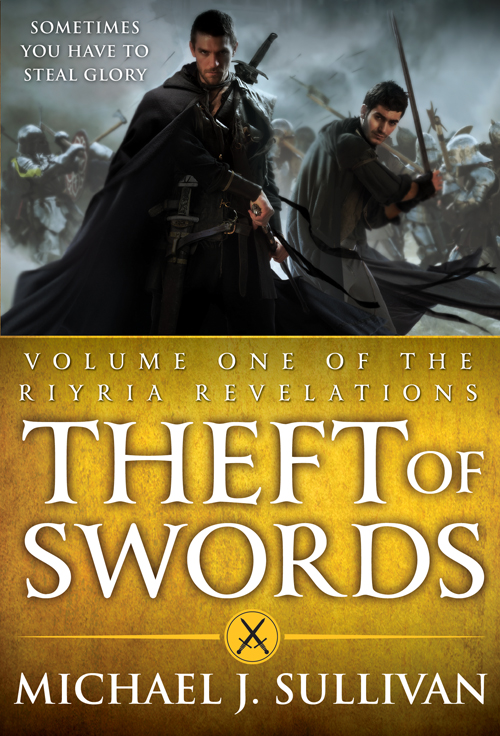
Theft of Swords

By Michael J. Sullivan
Paperback
Pages: 704 pages
Publisher: Orbit Books
Release Date: 23/11/11
ISBN: 0316187747

EXCERPT

Michael J. Sullivan has a story that every aspiring writer would love to tell. It’s not about trolls or princesses, vanquishing evil or finding treasure (at least not in the literal sense), but it is a tale of perseverance and personal triumph, of overcoming obstacles that prove impossible for so many others. See, Sullivan’s most interesting story isn’t that of Hadrian Blackwater and Royce Melborn, the protagonists of Theft of Swords, which consists of Sullivan’s first two self-published novels, The Crown Conspiracy and Avempartha, and the eponymous pair behind The Riyria Revelations, it’s the story behind his success, of his rocky and self-driven path to publication, first under his own publishing label (ostensibly a self-published writer) and selling several thousand eBooks a month to signing a full-fledged publishing deal with a major New York City publisher (and potentially leaving tens- or hundreds-of-thousands of dollars on the table.) Michael J. Sullivan is a self-made success story and it shows in Theft of Swords’ utter disregard for the current trends that are sweeping the Fantasy genre (and are so important in the minds of the major publishers.)

In this post-GRRM (George R.R. Martin, author of A Song of Ice and Fire) world, popular Epic Fantasy is dominated by so-called ‘gritty’ writers like Joe Abercrombie, Scott Lynch or R. Scott Bakker. Even the ‘good guys,’ like Brandon Sanderson, author of The Alloy of Law are known for attempting to subvert the tropes of the genre by taking common building blocks and flipping them on their heads in a way that’s supposed to upend the reader’s expectations. Theft of Swords, on the other hand, is a delightful throwback to the Fantasy of the ‘80s and ‘90s that took the concepts and thematic structures first popularized by Tolkien and helped solidify the genre’s place in popular geek culture. These days it’s cool to hate on Terry Brooks, David Eddings and Raymond E. Feist, but Theft of Swords proves that the building blocks used by those authors are still effective today when wielded by a careful author.
Read More »

The Shadow of the Wind by Carlos Ruiz Zafon

The Shadow of the Wind

AuthorCarlos Ruiz Zafon

Paperback
Pages: 487 pages
Publisher: Penguin
Release Date: January 25, 2005
ISBN-10: 0143034901

Years ago, when I last travelled through Europe, standing in the middle of a bustling bookstore in a Cologne train station, I held a copy of Carlos Ruiz Zafon’s The Shadow of the Wind in my hands. I contemplated it, having heard the first rumblings of the novel and its quality. I ended up putting it back on the shelf, not purchasing it. Ever since that day, I regretted not reading it on that trip, and so when it came time to hit the train stations of Europe, I made sure to bring a copy with me.

This time, as my train trundled its slow way through the quaint, rolling hills of northern Slovakia, I was gazing out the window, The Shadow of the Wind resting on the seat beside me.

“Ahh, I’ve read that one,” says the young man across from me, broken English tumbling its way inelegantly through his thick accent. “Museum of Forgotten Books, right?”

“Yeah,” I said, encouraged by his enthusiasm.

“It’s good. A good book,” he said.

The young fellow on the train may have had the name of the fabled Cemetery of Forgotten Books wrong (though it could have been lost in the Slovakian translation), but he certainly got one thing right – The Shadow of the Wind is a good book. A very good book.
Read More »