Posts Tagged: Science Fiction

Behind closed doors at E3, the largest videogame conference and tradeshow in the world, currently going on in Los Angeles, Square Enix, makers of the popular Final Fantasy series, debuted a stunning new game engine. The engine, dubbed Luminous Studio, was showcased in the form of a real-time short film inspired by Final Fantasy. The four minute film is a marvel of tech, art and sound design.

Keep in mind that what you’re seeing is being rendered in real-time, meaning that, if Square Enix’s projections for hardware specs are correct (and, to be fair, they’re probably optimistic), this is the potential level of quality that we could see in gameplay sections of videogames developed using Luminous Studio. It’s a little astounding. I remember, watching Toy Story, that I marvelled at the time when videogame graphics would surpass Pixar’s efforts. Watching this, I think it’s fair to say that real-time graphics have long ago left those films in the dust, even if they still can’t compete with Pixar’s latest films.

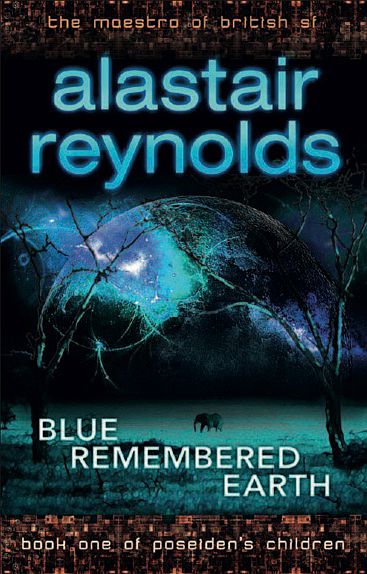
Blue Remembered Earth by Alistair Reynolds

Blue Remembered Earth

By Alastair Reynolds
Hardcover
Pages: 512 pages
Publisher: Ace
Release Date: 06/05/12
ISBN: 0441020712

EXCERPT

Blue Remembered Earth. Great title, isn’t it? The evocative image of leaving Earth behind, only to remember its color in the blackness of space. It’s an image that resonates on a visceral level. It also perfectly describes the nature of the technological period imagined — the moment when Earth no longer becomes the center of humanity. Vast in scope and dense with character development and world building, Alastair Reynold’s newest novel is a return to Utopian science fiction whose story isn’t about the darker side of humanity, but the boundaries of our collective horizons.

Set one hundred and fifty years in the future, Africa has become the dominant technological and economic power. Crime, war, disease, and poverty have been banished to history courtesy of mandatory implants that curb and/or correct deviant behavior. While humanity has colonized the nearby planets, Earth remains the center of attention with known(ish) physics underpinning the whole operation.

Geoffrey Akinya is heir to the corporate super power that makes much of it possible. He’s also a loner, living on the family estate and conducting experiments on the endangered elephant population that lives there. When his grandmother and company founder, Eunice, dies, Geoffrey’s more entrepreneurial cousins task him to ensure the family’s name remains unblemished after mysterious assets come to light.

Entitled rich kids, a black sheep, an artist, the old guy, and a few insensitive assholes.

It’s really as simple as that. Blue Remembered Earth is a classic quest novel. One clue leads to the next, leads to the next, leads to an eventual big reveal that opens up a host of new possibilities for future novels. Given this standard narrative structure, Reynolds’s novel places a premium on thematic exploration, characterizations, and world building. The degree to which he does it makes the novel a rousing success despite a plot that’s as inventive as hyperdrive.
Read More »

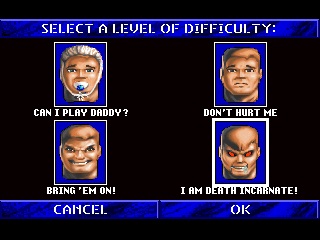
Wolfenstein 3D difficulty settings

John Scalzi published an article today on his blog titled “Straight White Male: The Lowest Difficulty Setting There Is.” I felt the need to pass it along, without much in the way of comment. It’s not exactly related to the usual topics covered here on A Dribble of Ink, but it’s interesting, important and Scalzi’s a prominent figure in our community. Gender is a hot-topic issue in the SFF community these days (see here, and here, and here) and Scalzi, as he traditionally does, tackles the subject of gender- and race-privilege with an even hand. The “fun” really begins in the comments section, as is wont to happen on the Internet.

Dudes. Imagine life here in the US — or indeed, pretty much anywhere in the Western world — is a massive role playing game, like World of Warcraft except appallingly mundane, where most quests involve the acquisition of money, cell phones and donuts, although not always at the same time. Let’s call it The Real World. You have installed The Real World on your computer and are about to start playing, but first you go to the settings tab to bind your keys, fiddle with your defaults, and choose the difficulty setting for the game. Got it?

[…]

Now, once you’ve selected the “Straight White Male” difficulty setting, you still have to create a character, and how many points you get to start — and how they are apportioned — will make a difference. Initially the computer will tell you how many points you get and how they are divided up. If you start with 25 points, and your dump stat is wealth, well, then you may be kind of screwed. If you start with 250 points and your dump stat is charisma, well, then you’re probably fine. Be aware the computer makes it difficult to start with more than 30 points; people on higher difficulty settings generally start with even fewer than that.

[…]

You can lose playing on the lowest difficulty setting. The lowest difficulty setting is still the easiest setting to win on. The player who plays on the “Gay Minority Female” setting? Hardcore.

Please, read it and let me know what you think.

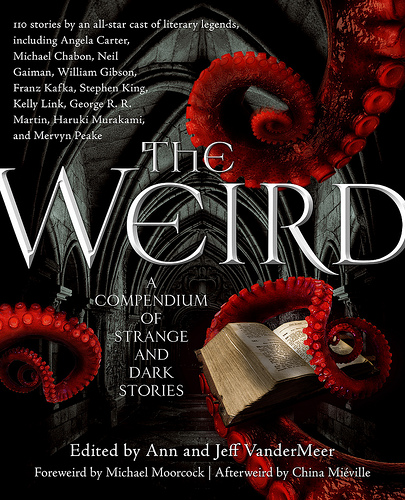
The Weird, edited by Ann and Jeff VandermeerThis week saw the publication in the U.S. of a massive (Amazon shipping weight for the hardcover: 3.1 pounds!) new anthology of fantastic literature: Ann and Jeff VanderMeer’s The Weird: A Compendium of Strange and Dark Stories. Initially published in the U.K. by Corvus last fall, this book contains 110 stories of fabulous, bizarre, sometimes esoteric weirdness. I read the whole thing at the end of last year, and it has produced a lot of fodder for contemplation. I found it difficult to write a brief, crisp review of it (although a review is in progress), but what really made this book significant to me is that I have been able to turn the stories over and over in my mind and find insights into reading, writing, story, genre, and some tenebrous insights into how I look at life and reality. Even better, some of the stories require you to struggle, to navigate your way through discomfort and perplexity, to really experience their value. I’ve written about it several times, and it has inspired a chapter in the book I’m currently working on. What’s great about The Weird is that you can find all kinds of odd, perplexing, sometimes horrible things in it, and once you take them in they start to worm themselves into your thoughts and ideas.

Well, they do for me at least.

And this is what I want to discuss in this blog post: the idea not just of weird fiction, but of how genre expectations — as reading frameworks — condition our engagement with fantastic literature. We all have our preferred categorizations for the stories we read: some people like SF, others speculative fiction or fantastic fiction. Some readers want to organize stories more precisely, right down to very specific sub-genres like paranormal romance or steampunk. Some people like micro-designations, while others like a big playing field. Myself, I was a rabid, obsessive parser of subgenres as a younger reader, but I found after some years that I was reading the same sort of stuff constantly, and I was getting, well, bored. I came to realize that my problem was with how I looked at genre, how I used genre and how my expectations and assumptions influenced my reading of a story. I have evolved into a big-tent sort of reader of fantastic fiction, to the point where I prefer to use the term fantastika, precisely because it opens doors into stories rather than closing them. It also incites discussions about genre and how we look at the stories we enjoy reading, and I like that. Read More »