Posts Tagged: Science Fiction

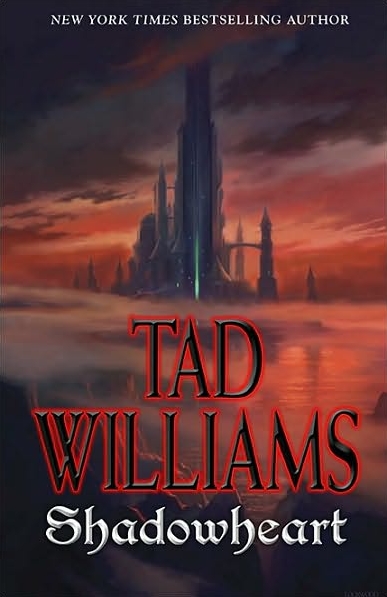
SHADOWHEART by Tad WilliamsOver at Bookworm Blues, Sarah Chorn is running a series of thematic guest blog posts about the place of disability, whether physical, mental or other, in Speculative Fiction. She’s calling the event “Special Needs in Strange Worlds” and already has several articles from various bloggers and writers about the topic. One of those guest bloggers is me.

Here’s an excerpt from my article, which considers Tad Williams’ Shadowmarch series (beware of spoilers for the entire series):

One of my favourite characters in Memory, Sorrow and Thorn was Prince Josua, a rebellious prince who was the fulcrum of a rebellion that forms the core for much of the trilogy. It happens that Josua was missing a hand. This was a defining feature for Josua, in a visual sense, but had little-to-no effect on his being able to achieve his goals. It’s hard to believe that George R.R. Martin wasn’t influenced by Josua when one of his own characters loses a hand, though Martin takes the concept further, exploring how the loss of his character’s sword-hand affects not only his ability to compete physically against other characters, but how the loss of skill and ability can alter and manipulate a person’s outlook on life. Losing that hand is a major catalyst in allowing Martin’s character to evolve into one of A Song of Ice and Fire’s most conflicted and compelling characters.

[…]

Throughout the course of the latter two volumes in the series, as a result of both his bloodline and being exposed to the magic of the alien Qar, Barrick begins to overcome his physical disabilities. At first it seems like a cop-out by the author, a deus ex machina that allows Barrick to become ‘whole,’ but Williams is too smart for that and Barrick soon realizes that his physical disabilities are, in many ways, a smaller prison compared to the crippling social disabilities he created within himself as a guard against the sympathies of the other people in his life, including his sister, though he loves her dearly. The prince can never crawl out from under the shadow of his disabilities; though his body is healthy, his mind continues to be plagued by the demons of his own devices. Barrick’s lifelong struggle with his disabilities is a defining aspect of his character, and an intelligent foil to the struggles of his sister—where Barrick inwardly deals with the physical and mental shackles placed on his by his disabilities, Briony, physically healthy, must battle equally confining restrictions placed on her by society for being a female fighting for her place in society. To overcome his disabilities, Barrick must first convince himself that it’s possible, for Briony, she must convinces the others that surround her. It’s tough to say who has the more difficult road.

The Shadowmarch series is filled with characters who deal with varying degrees of physical disability, but it never stops a single one of them from having an important and positive impact on their imperiled world. Though a character like Ferras Vansen is physically strong and suffers only from a melancholy heart, his struggles are as difficult and important to him as those faced the physically-challenged Prusus. Different, yes, but equally demanding.

Sarah also writes some flattering things about me and A Dribble of Ink that set equally my ego and my humility into swirling mayhem. So, yes, thank you, Sarah, for inviting me to be a part of this event.

I hope you enjoy my article and encourage you to read the others, they’re all much more eloquent and better considered than my own. In particular, young Dan Goodman, who was diagnosed at birth with spastic cerebral palsy, writes well about the topic and how Fantasy allowed him to find a freedom he didn’t know he could have. Touching stuff.
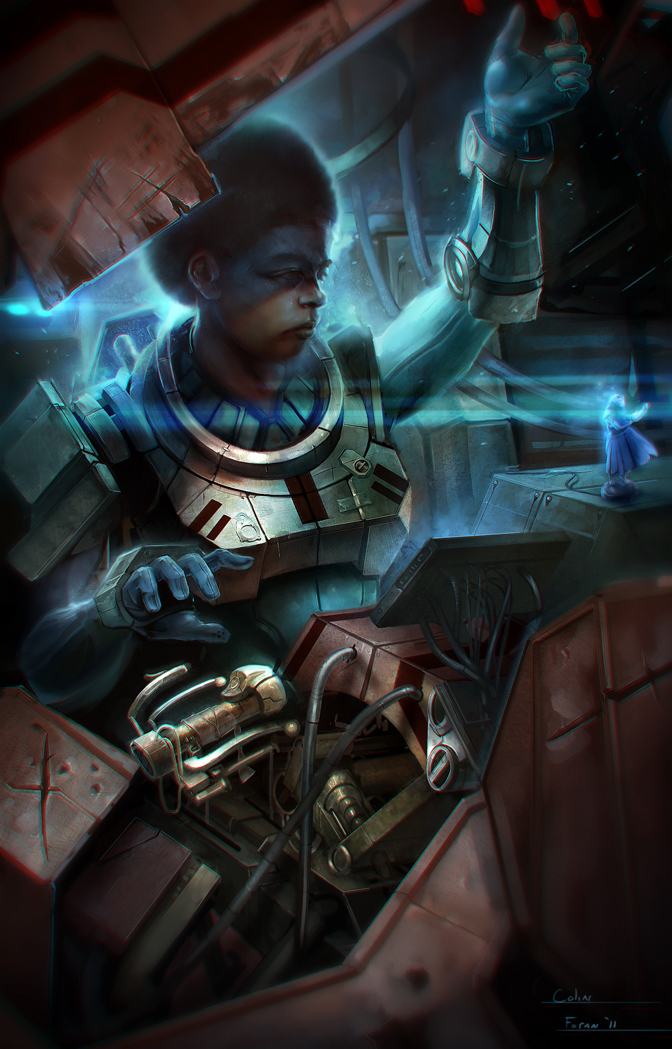
Suitup 3, Art by Nathan Twist: http://nathantwist.deviantart.com/art/Suitup-3-215636699

Recently, I read one of the most wonderful anecdotes I’d ever heard. Nichelle Nichols, who played Lt. Uhura on Star Trek, gave the keynote speech at Goddard’s 2012 Martin Luther King, Jr., and African-American History Month commemorative presentation. After Star Trek’s first season, she was set to leave. The stage was her first love and she wanted to pursue that instead of the television show. After confessing her feelings to Gene Roddenberry, he asked her to take the weekend to reconsider. That weekend she attended a NAACP fundraiser. During the event, she was asked if she would talk to a fan.

“I stood up and turned around, and looked into the beautiful face of Dr. Martin Luther King—my leader!” Nichols said. They discussed the cultural significance of Nichols’s role and her intent to depart television for the stage. She reflected on King’s response: “You cannot leave; you cannot abdicate,” he told her. “You don’t know what you mean to us. Every night that you’re on, we can look on and see what we’re fighting for.”

Her choice to remain created long-lasting ripples. Mae Jemison, a former NASA astronaut, cited Uhura as an inspiration for becoming an astronaut. Nichols’ work as a NASA recruiter also impacted the decisions of Sally Ride, Guion Bluford, Judith Resnik, and Ronald McNair. Whoopi Goldberg also points to Uhura as a turning point in her life, recalling that she ran through the house saying “I just saw a black woman on television; and she ain’t no maid!”

Without characters such as Uhura, we run into what Chimamanda Adichie calls “The Danger of One Story.” In her TED talk, the novelist discusses her childhood in Nigeria and recalls a number of instances where she or another found that their view of others was mistaken because they had only heard one story, one view of the others’ life. She starts with her experience reading foreign books as a young girl, how she came away with the belief that books had to have foreign characters and things she didn’t recognize from her own life. Until she discovered African literature, she did not realize that people like her could be characters in books.

Read More »

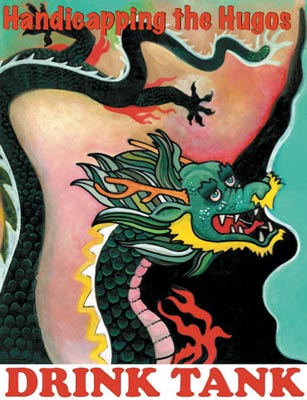
The Drink Tank #315, Handicapping the HugosIssue #315 of The Drink Tank, the Hugo Award-nominated fanzine edited by Christopher J. Garcia and James Bacon, just hit newstands efanzines.com and it’s dedicated entirely to examining this year’s Hugo ballot. It’s called “Handicapping the Hugos.”

Also included are thoughts on the awards from Charlie Jane Anders, Niall Harrison and some guy named “Aidan Mohr.” Despite the mispelling of my name, I’m absolutely thrilled to have been invited to take part in the analysis with several other Hugo-nominated fan writers (and Niall Harrison, who, damnit, should be a Hugo-nominated fan writer by this point,) all of whom have a strong online presence.

Also of interest are Garcia’s thoughts on the inclusion of SF Signal in the “Best Fanzine” category:

OK, there’s been a lot of folks in the blog community that were not happy with the Hugos last year.

They point out that much of fandom is blogs and podcasts and so on and they wanted to see them represented on the Hugo ballot. And there were others who didn’t like that and it went on and on. Aidan Mohr [sic] was one of the loudest folks decrying the lack of blogs and so on. There were others, but his were the most widely discussed among the folks I know. This nomination was probably not directly tied, though even I was a little surprised that it didn’t do better in the nominations last year . I expect it to destroy the rest of us completely. [W]hen it ended up somewhere around number 13 or so. It’s got a huge following, far bigger than any of the other nominees, or probably eFanzines.com in total!

So, go read “Handicapping the Hugos”, The Drink Tank #315. You’ll find insight into the ballot and also and interesting look at how another portion of the fan community views the awards and the nominated books/stories/writers/editors.

If you’re interested in learning more about The Drink Tank, its editors and the fanzine culture in general, check out Garcia’s “Ma Vie En Zines,” and article he recently wrote for A Dribble of Ink exploring fanzine history and culture.

Frankly my dear, I don't give a damn.This week, Justin Landon, editor of Staffer’s Book Review, hosted a series of guest articles discussing and exploring the idea of “agency” in Science Fiction and Fantasy. The term means different things to different people, and many readers might not even recognize it when they see it, but it’s at the core of almost every successful novel. In particular, Landon was interested in applying the idea of agency against the role and development of female characters in Fantasy and Science Fiction, and how it differs from that of male characters.

Landon explains the genesis of the project:

I’ve noticed more and more authors lamenting the treatment of women in fantasy novels. Despite widespread agreement that there should be a more concerted effort to depict strong women, I wasn’t necessarily coming away with the impression that agency is something a character has to have.

So, Landon prompted several of Fantasy and Science Fiction writers with a few questions to encourage the discussion of character agency, how it affects the driving force of novels, and its role in the overall debate centred around gender and SFF. The questions were:

What is agency?
Why is it important?
Why do we find more male characters with agency in fantasy novels than females?
Is it OK if a character doesn’t have it?
Can a character still be interesting if it lacks it?
Can a book be good if none of the characters have it?

Landon has published the responses from several authors, with promises of more to come. Here’s a collection of their thoughts, along with links to the full articles:

Elizabeth Bear, author of Range of Ghosts:

Agency, as we use the term in literary circles, is–quite frankly–the thing that makes characters interesting to the reader. As much as we talk about tactics of characterization that may or may not appeal to any particular reader (making the character accessible, making them funny, making them identifiable)… the one thing that I have found that does not fail to connect to the audience is giving a character agency.

[…]

A lot of people use the term “strong female character” to mean “kickass heroine.” I think this is silly. In my estimation, one of the strongest women in Range of Ghosts never picks up a weapon. She’s a fourteen-year-old-girl who escapes execution for being pregnant with the wrong man’s child by running across a desert at night in her bedroom slippers.

That’s pretty damned tough. She wants to live, and she wants her child to live, and she does what she has to do to make it happen.

[…]

As for why female characters have it less often than male ones? Well, there’s an implicit assumption in the question that I’m not sure I agree with. Do they really? Does Lessa have less agency than F’lar? Does Juliet have less agency than Romeo? Does Jessica have less agency than Paul? Does Elizabeth have less agency than Mr. Darcy?

Women may have traditionally had to express their agency in more limited ways–but that doesn’t mean it’s not there. Just that they were pushing a bigger boulder uphill to express what they want, and their options on what to do to get it were more limited.

Read More »