“Be warned, then: the collected volumes of this series will contain frozen mountains, foetid swamps, hostile foreigners, hostile fellow countrymen, the occasional hostile family member, bad decisions, misadventures in orienteering, diseases of an unromantic sort, and a plentitude of mud. You continue at your own risk. It is not for the faint of heart – no more so than the study of dragons itself.”
So states the preface of Marie Brennan’s A Natural History of Dragons: A Memoir by Lady Trent, the first volume in a projected series recording the life and times of the eponymous heroine, a self-taught dragon naturalist living in Scirland, which is more or less an analogue for Victorian England. This first book constitutes an accounting of Isabella’s childhood and adolescence, her marriage to Jacob Camherst, an academic, and their expedition to the mountains of Vystrana (which is more or less an analogue for Romania) to learn about dragons, which ends up being complicated by both the local religion and political intrigues.
A Natural History of Dragons is thematically much less concerned with dragons than the sexist social attitudes which attempt to curtail Isabella’s interest in them.
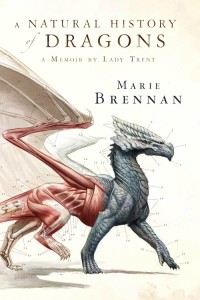
In hindsight, the dissonance between my expectations for this book and what it actually turned out to be is a contributing factor in my ambivalence towards it. Having been seduced by the undeniably beautiful cover art, I envisaged a story with a strong, primary focus on dragons – their physiognomy, habits, breeds and other peculiarities – set against a backdrop of detailed magic-scientific worldbuilding; something like an adult, novelised version of Graeme Base’s classic The Discovery of Dragons, perhaps. In my defence, I suspect this is an impression that the cover, title and preface all strive to convey to some extent, and it may well be that this constitutes an accurate assessment of the series as a whole. This first book, however, is thematically much less concerned with dragons than the sexist social attitudes which attempt to curtail Isabella’s interest in them, and as such functions more as a protracted justification as to how and why a Scirling lady ended up as a scholar and explorer than as a natural history. Obviously, dragons still make an appearance, but having anticipated a story that was primarily an adventure, it came as something of a let-down to find myself reading one that was much more internal and domestic. Read More »
Publisher: Tor Books -
Pages: 320 -
Buy: Book/eBook
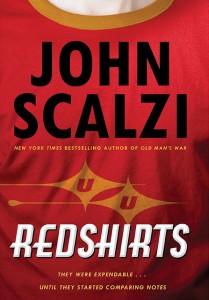
Like many twenty-something Science Fiction fans, I grew up with a love of Star Trek and Star Wars (yeah, both of ’em. Come at me!) gifted to me by a family member. Star Trek, in particular, was a shared interest between me and my mom. I couldn’t match her, who read every novel published, and watched every episode of every series, in her enthusiasm, but I hold a fond spot in my heart for Geordi La Forge, Data and Quark, and even before-my-time Sulu and Kirk. That love in mind, Redshirts was of particular interest to me in its attempt to deconstruct the lazy narrative ambitions of network television and the Science Fiction genre as a whole.
The main narrative in Redshirts is told through a tight third-person voice, following Ensign Dahl, who, in very un-Scalzi-like fashion, is plain. Yeah, he’s also likable, like all of Scalzi’s other protagonists, but lacks the acidic tongue and wit that usually marks Scalzi’s other stars. This plain personality is even discussed at one point, when two characters examine his place in the overall narrative. They eventually peg as the everyman protagonist — which, of course, he is. The rest of the cast, however, more than makes up for this plainness, and Scalzi’s trademark humour and mile-a-minute dialogue hums along as expected. Read More »
Publisher: Tor Books -
Pages: 720 -
Buy: Book/eBook
I’ve reached the halfway point at least in this series to date. Death is like a feather, duty like a mountain, and around 5000 pages of WoT is like carrying a 400 lb. woman wearing spandex and a tube top on your shoulders as you run up that mountain. Not the most pleasant of images, true, but this book was much more of a slog than the previous book, The Fires of Heaven, had proven to be.
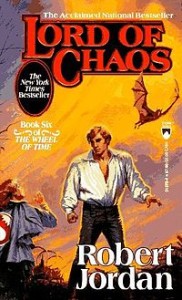
When I first read Lord of Chaos back in November 1997, I even then found it to be the most difficult of the seven books to date to enjoy. Back then, used as I was to reading cultural and religious histories in English and German, it wasn’t the size of the novel that daunted me but rather how disjointed it felt. Nearly 13 years later, that sense of disjointedness was even more pronounced. It was a struggle at times to pay attention to what was transpiring, which might explain in a perverse fit of reasoning why I am reviewing it so soon after completing it (I finished it about an hour before I began writing this post), when I typically wait 1-2 days. Between the often-interchangeable character types (Aes Sedai, Cairhein, Aiel, Forsaken, Tairens, etc.) and the over-explanations of things that I first read about several books ago, I fear my own complaints may become just as repetitive if I don’t spice them up with some actual observations. Read More »
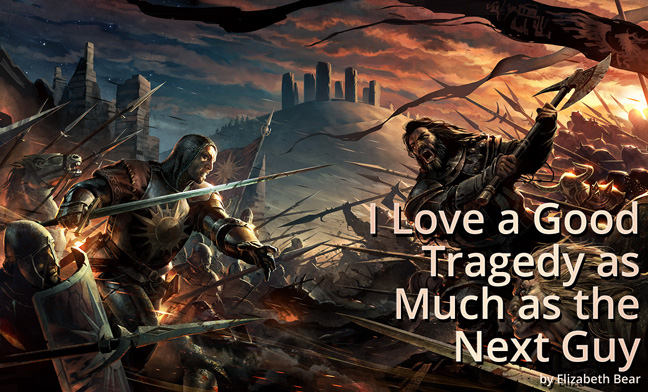
The conversation in the genre blogosphere lately has been leaning heavily to grittiness, grimdark, and whether they serve a purpose—and whether there’s any difference between the two. A lot of bloggers and commenters seem to be settling on the idea that “grimdark” is the pejorative, so perhaps that is how I will use it here.
Now, I love a good tragedy as much as the next guy. If the next guy is William Shakespeare.
I believe in fiction where actions have consequences, and sometimes terrible prices are paid, and sometimes good people meet fates you wouldn’t wish on Count Rugen. I would argue that darkness and uncertainty are a needful thing; that without them, there are no stakes, no emotional engagement. Read More »
The great old stories break and bend rules modern audiences take for granted. For example: Journey to the West, which I talked about last month, is a story of high-flying magic, transformation, kung fu, divine war, and so on—that, for all its epic scope, reads more like Sword and Sorcery.
That is, to borrow Liz Bourke’s definition of S&S: Journey to the West is a story of encounter, in which central characters going about their daily business keep running into strange, fascinating, terrifying things—and befriending them, or beating them about the head and shoulders, or both.
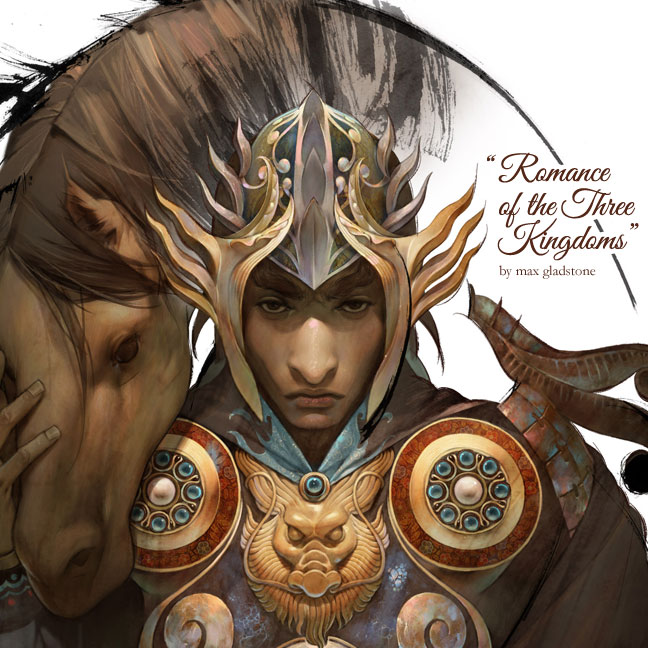
By contrast, let’s talk about one of the best war-and-intrigue novels of all time, the Romance of the Three Kingdoms. At first glance, Three Kingdoms seems an epic fantasy, in that it describes the fall of a massive empire through the lens of central characters with dynastic ambition. But, though set in a time of miracles, Three Kingdoms relies on the traditional Sword & Sorcery mix of cleverness, combat, and betrayal rather than prophecy or magic. Read More »