Posts Categorized: Feature Article

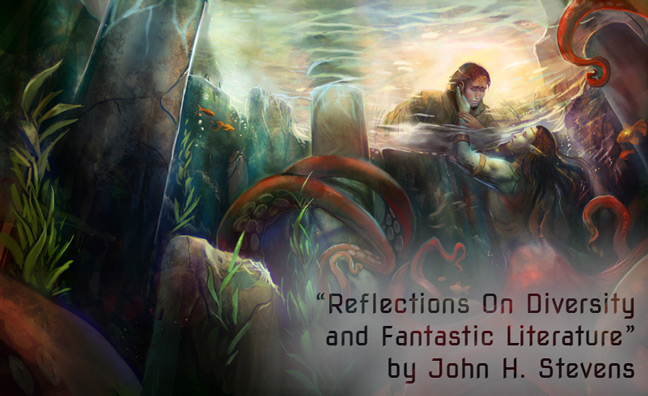
Last week Aidan wrote a post stating, quite simply, that he had decided to take the Goodreads Challenge to read a certain number of books this year. He also wrote that he was going to consciously strive for “an equal split of gender” in his reading. There was no judgment of others’ reading habits in the post, just a pledge on his part to find more female authors and diversify the range of novels he was reading. And while some commenters applauded Aidan’s idea, others found it problematic, if not implicitly damning of their own method of choosing novels to read. A spirited discussion ensued and as I followed it I wondered about my own reading patterns and habits in relation to balance and diversity.

I read a pretty narrow range of fantastic fiction, mostly space opera and epic fantasy, when I started reading fantastika intentionally. I had a soft spot for sword-and sorcery and for dystopian writing, for planetary romance and, briefly, military SF. Early in my mature reading life (early 1980s) I was fortunate to be pointed to authors from more diverse backgrounds – authors such as Delany and Disch and Russ – but they were a few different voices in a much wider realm of heroic fantasies and crackerjack adventures. It took some conscious thought to branch out further into the much wider field of fantastika. It was exciting and comfortable to keep reading the literary descendents of Asimov, Heinlein, and Bradbury, but I soon felt like a magpie looking for more shiny things that could line my nest. And that was not what I was looking for out of literature. Read More »
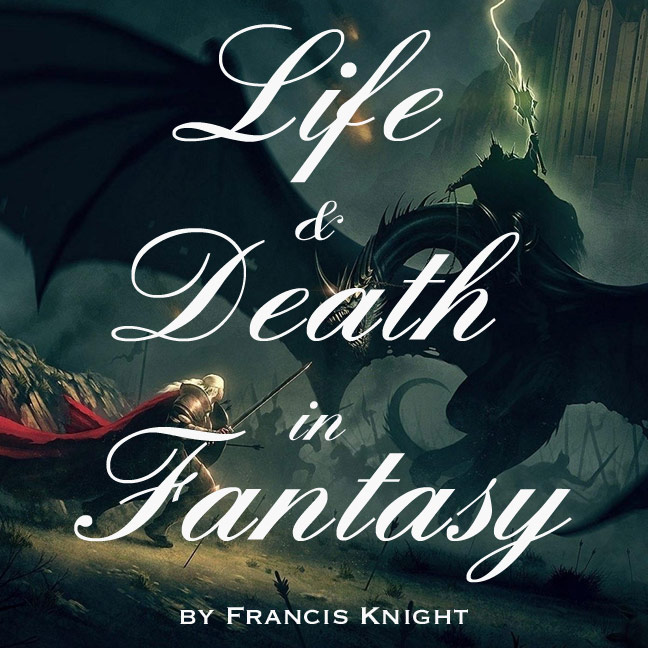
Fiction, it often seems to me is becoming more preoccupied with deaths, both death itself and the manner of it in nasty, gruesome ways. Why? Many reasons I’m sure – a more cynical age for one. Another is the western obsession with Youth and Beauty as though they alone can stave off Death and Decay. As a society we are more personally removed from death than at any time in history, yet via media at the same time we are exposed – at an emotional distance – to deaths we would once never have known about. Where once bodies were laid out by their family, washed, dressed, respects given, now they are hidden away in their coffins, dressed by strangers, almost as though we’re ashamed that one of us let death overtake him. It is no longer a part and parcel of our lives in the same way – ably demonstrated by my co worker, who moonlights as an embalmer. When she tells people, almost every reaction is a variation on ‘Ewww, you touch dead people!’. So, with death removed from our real lives, less matter-of-factly “there”, perhaps we delve into it more in fiction, because it’s one of the few places we have left. Read More »

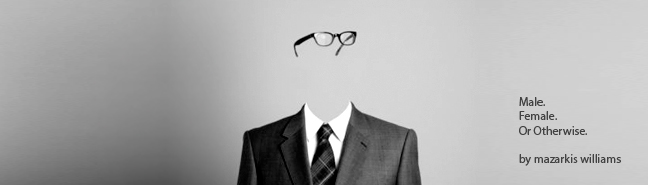
Male. Female. Or Otherwise. by Mazarkis Williams

An author from an online writing group once offered some advice. He said a homosexual character should never be included in a story unless his/her sexual preference figured into the plot. Otherwise, it was a distraction, he said. To him, a gay character stood out—didn’t fit—and anything non-default about a character should be important to the plot.

Sometimes I get a dizzy feeling and I think I’m communicating with someone from another planet. This was one of those times. The idea that all characters must fit to some ‘default’ expectation threw me. How would I know who all my readers were, and what the ‘default’ was for them? Were they all straight? White? Middle-class? I didn’t think so. And where does one have to live so that homosexuals stand out as unusual? Yes, I have lived in urban areas most of my life, but still. Still. Even for an extremely plot-oriented writer (for whom characters are tools of the story), this guy was missing something.

So. Reader expectations. I cannot possibly guess what they are. I can comment only on reader behaviour, and that may reveal a bit about their expectations. And the first thing that comes to mind is that, as a member of both the fantasy/sci-fi community and the adjacent gaming community, I see a lot of discomfort with gender issues.

Read More »

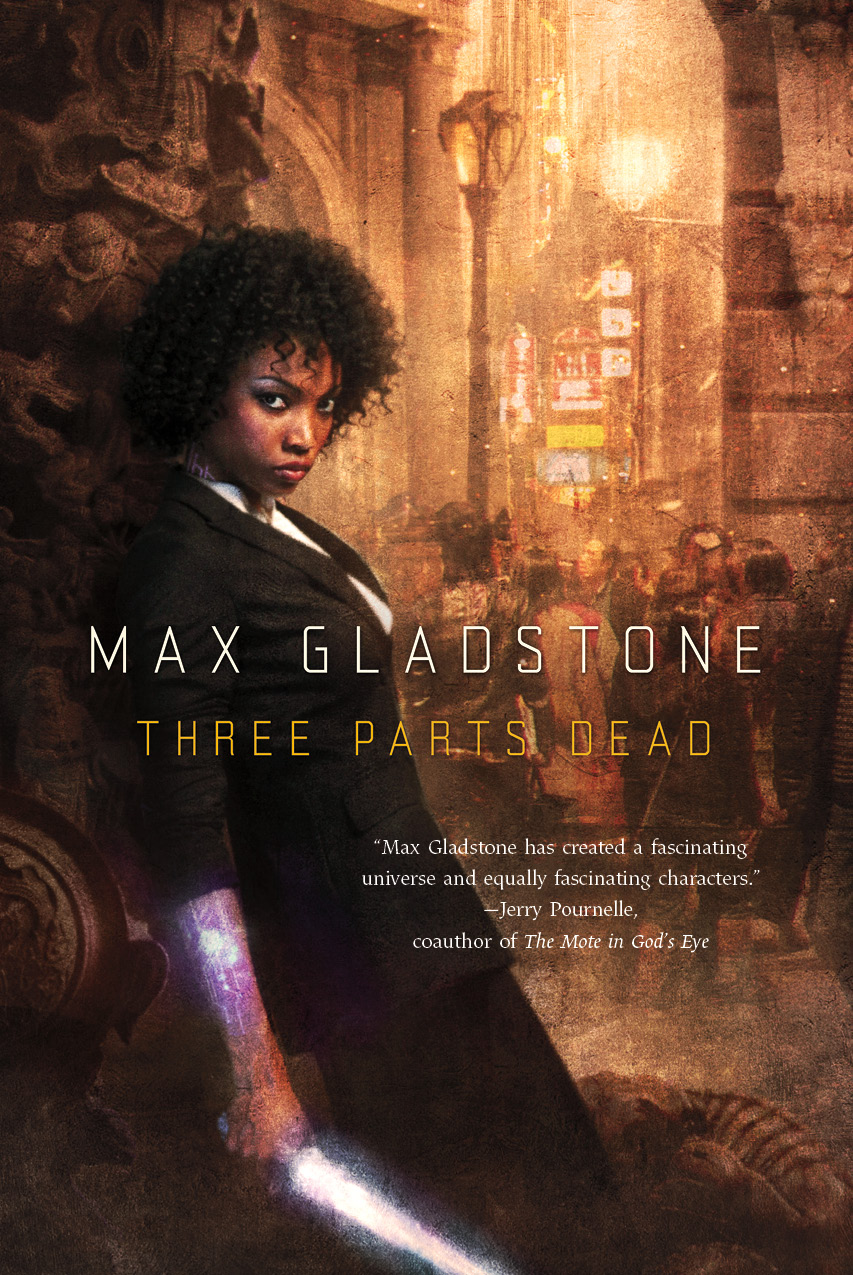
Three Parts Dead by Max GladstoneA few weeks ago, when I asked Justin Landon for a review to run on A Dribble of Ink, he offered me two. The first, which I ran, was for The City’s Son by Tom Pollock. It had great cover art, sounded intriguing and didn’t look like just another gritty Urban Fantasy novel. The other was Three Parts Dead by Max Gladstone, which I’d never heard of.

Justin Landon, Staffer’s Book Review:

Gladstone’s uses dynamic prose and a unique voice to communicate that intent. It’s poetic at times, and laconic at others, switching between the two, and in between, depending on the point of view from whence the story is told.

[…]

For fans of the legal thriller, and they are legion in the fiction marketplace, Three Parts Dead is an intriguing starting position for a fantasy enfilade. Elements of mystery, verbal fencing, and suspenseful confrontations stand tall throughout, set neatly into a fantasy world. I have concerns that traditional fans of fantasy may feel some frustration about the lack of development in Gladstone’s setting, but his excellent characters and interesting plot carry the day, making it a novel I can easily recommend.

Read More »

Jumpboarding off of a recent article by Justin Landon of Staffer’s Book Review, also titled ‘The 5 Most Influential Books in My Life,’ I’ve compiled a list of the five books, novel or otherwise, that I feel most influenced me, my reading habits, and my life. As with lists of this nature, I’m sure it would be different if I compiled the list tomorrow, and different again if I compiled it a week from now, but, in this bubble of my life, the (unordered) list looks like:

  • Jurassic Park by Michael Crichton

    Jurassic Park

    by Michael Crichton

    I discovered Michael Crichton at a young age. I was nine, and a dinosaur nut. With the impending release of the film adaptation of Jurassic Park, excitement filled me in a way that can only happen to little boys and little girls. Jurassic Park was my life. My parents bought me the book, and I still remember sitting in the theatre, lights dimming, trying desperately to finish it before the movie began. I didn’t, the theatre grew too dark before I was able to turn the final pages, but then I became lost in Spieberg’s vision of the iconic novel. Nine might seem young to get into Crichton’s work (most of my friends were reading the books assigned in school, more inline with our grade level, if reading at all), but, to this day, I don’t think I’ve ever been so enveloped by a novel as I was with Jurassic Park. I went on to re-read the novel several times over the next handful of years. It was the first book that I was absolutely obsessed with and helped introduce me to the world of speculative fiction.

Read More »