Posts Categorized: Feature Article

"This is an Emergency Test of Your Magic System" by Josh Vogt - An image from MISTBORN: BIRTHRIGHT
Creating a new magic system isn’t all that hard. Do I hear a few dissenters in the audience? For the sake of the next exercise, let’s assume I do. Time to play a quick round of Magic Mad-libs!

Fill in the blanks:
“In a(n) adjective world populated by noun, practitioners known as made-up-word can call upon energy source to fuel a form of noun magic.”

What’d you come up with? In a forested world populated by squirrels, practitioners known as fuzzummoners can call upon mystical oak trees to fuel a form of acorn magic? Me too! Weird.

Once a basic concept is pinned down, it’s still not difficult to flesh out the system. There are so many types of magic systems swarming the shelves these days, they’ve started to lump into familiar categories. Here are a few common approaches:

  • Beakers full of fairy dust – This is magic as science. The fuzzummoners exist within a universe that has an extra level or two of physics, with established rules that govern their acorn spell-casting. (Think pretty much any book by Brandon Sanderson.) Or the fuzzummoners have stumbled across mysterious, ancient—possibly alien—doohickeys that are so far beyond their comprehension it might as well be magic.
  • The mythology wood-chipper – Fuzzummoners are just one supernatural faction alongside Norse gods, dragons, trolls, vampires, and whatever else gets thrown into the mix for variety’s sake. (Jim Butcher’s Dresden Files series is a great example.) Bit of a magical free-for-all where anything goes (Also look at T.A. Pratt’s Marla Mason series).
  • Is that a D20 in your pocket? –The fuzzummoners magic originates from a roleplaying world with game mechanics complicated enough to boggle Jeopardy’s Watson. Whether a tabletop or video game, the gameplay came first, the stories came later. (Look to the Pathfinders Tales series as a current example, plus plenty of other media tie-ins.)

If creating the magic system isn’t hard, what’s the difficult part then? Read More »
Sharps by K.J. Parker

I was at the bookstore yesterday and noticed a copy of Sharps sitting there, hidden away between several other books. I didn’t realize it was out, my wife was still busy elsewhere in the bookstore and some of my friends have recently raved about Parker’s work, and Sharps in particular. So, I picked it up and started leafing through it. What’s the harm, right? It goes without saying that I really enjoyed the small bit of the book I browsed through, otherwise I wouldn’t be writing this post.

Synopsis

For the first time in nearly forty years, an uneasy truce has been called between two neighbouring kingdoms. The war has been long and brutal, fought over the usual things: resources, land, money…

Now, there is a chance for peace. Diplomatic talks have begun and with them, the games. Two teams of fencers represent their nations at this pivotal moment.

When the future of the world lies balanced on the point of a rapier, one misstep could mean ruin for all. Human nature being what it is, does peace really have a chance?

Reviews

Jared Shurin, Pornokitsch:

Sharps is, for lack of a more poetic way to put it, the first commercial KJ Parker novel. The one where the elevator pitch – swords, sports and diplomacy – is just as appealing as the text itself. And you know what? It is marvellous. Sharps not only has all the wit and complexity of Parker’s other work but also hearty doses of glory, romance and adventure.

[…]

Sharps also appeals through its surprisingly epic scope. Although a long way from writing a ‘chosen one’ narrative, the book has a more familiar fantasy structure than Parker’s other work: five reluctant heroes are off to save the world. Parker has repeatedly written about the impact of small people on great powers, but, in the past, the focus has been entirely on the individual. The Engineer Trilogy, for example, is about one man’s plot to change the face of the world. But the face of the world is incidental: all he wants is to go home. The Folding Knife is similar – a man sets out to forge an empire, but all he really desires is the love of his family.

[…]

With all the flying steel of Sharps, a bit of swash and buckle is inevitable, yet Parker stays on message: life and death, politics and war – all riveting stuff, but they’re never games. And for those that persist in taking these things lightly: Here they fight with messers. God help them.

Packed with sharp edges and provocative points, Sharps may be the book that fantasy readers have been waiting for. Not necessarily for Sharps qua Sharps (although it is undeniably great) but because its crowd-pleasing premise should serve as the long-awaited gateway drug to Parker’s entire world.

Read More »

A Dance with Dragons... a year later

When A Dance with Dragons was released, I didn’t write a review of it, in fact, I barely discussed within my community of fellow Fantasy fans. I wrote a piece or two about it, debated a bit with friends, but otherwise, I let one of Fantasy’s most impactful and anticipated releases slip me by. This is odd given that I run a fairly well trafficked Fantasy and Science Fiction publication, A Dribble of Ink, and a lot of my readers were interested in hearing my take on the fifth volume of Martin’s mega-successful A Song of Ice and Fire. But, I let them down, and, a year later, I’ve thought a lot of why I never wrote about the book, never formally reviewed it, despite enjoying it a fair bit more than the average fan seems to have, and it’s all because of expectations. Mine, and those of the fans around the world.

At first, as an entrenched fan, I felt special. Because, you see, I’d discovered Martin years earlier. He was my little secret. But, then it became clear that Martin wasn’t just a fad, wasn’t just a passing ghost of geekdom on the mainstream, he was a real thing. Maybe it was seeing Martin spoofed on Saturday Night Live, or when he was sitting there in the crowd at the Emmys, but finally it clicked with me. He’s not my secret anymore. Hell, he’s not even our secret anymore. Fantasy has a new ringleader, he wears a Greek sailor’s hat, thick glasses, and rides a wave of popularity the likes the genre hasn’t seen since The Lord of the Rings. Read More »

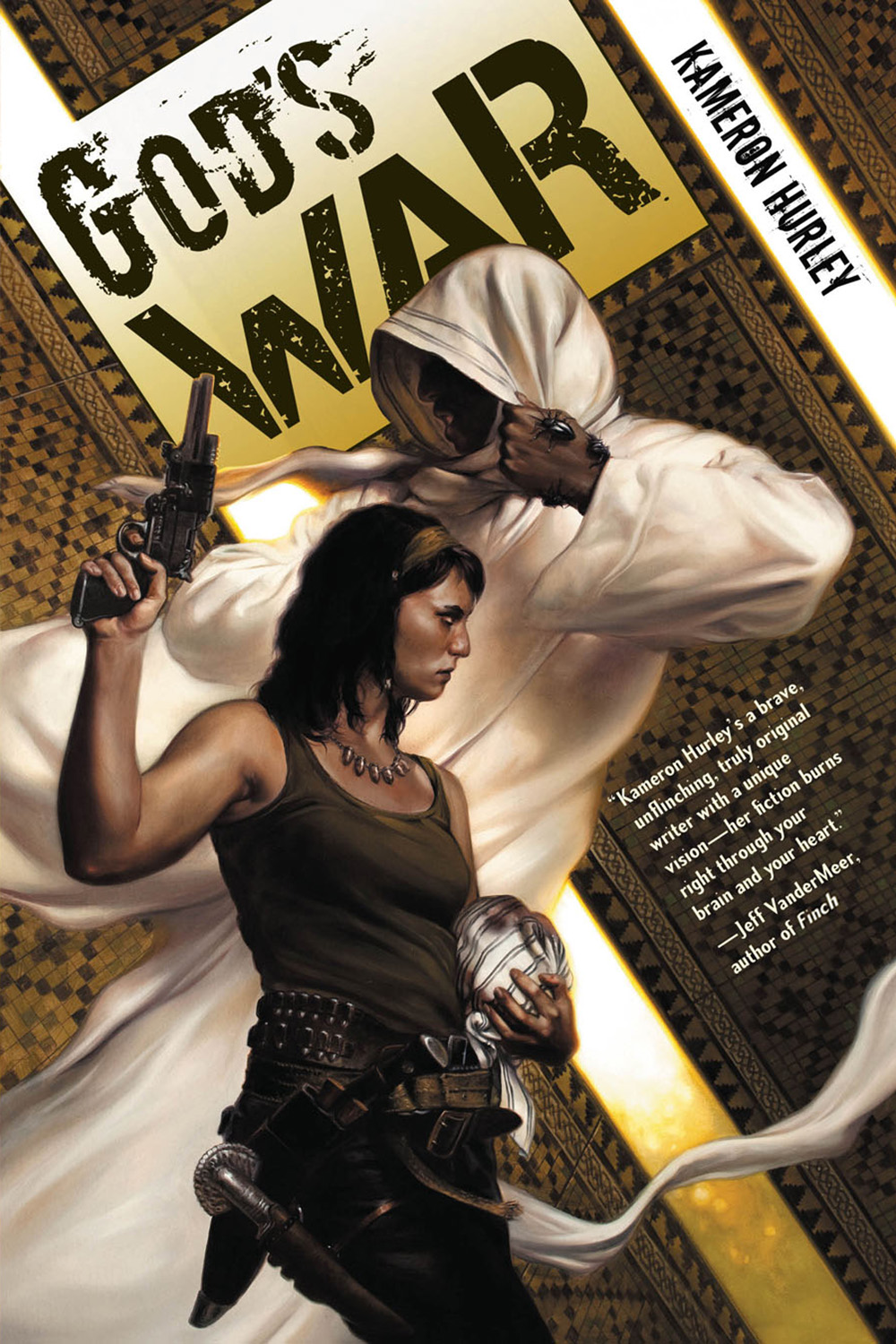
God's War by Kameron Hurley

In 2011, after much angst and delay, my first novel, God’s War, came out from Night Shade Books. It went on to win the Kitschy Award for Best Debut Novel and was nominated for a Nebula Award as well as a Locus Award for Best First Novel. I earned out my advance in about six months and sealed the deal for the third book in the series not long after that. I’ve also just sold UK and audio rights for all three novels in the series.

Looks like a smashing good success all around when you string it all together like that, doesn’t it? In fact, it looks almost miraculously easy, as if I must have written some kind of exceptional book or something. Now, don’t get me wrong. I love my books. But I also read a lot of other books in 2011 that I thought were a lot better, some of which didn’t make any awards list and many of which are still earning out their (probably substantially larger) advances.

So how did this happen? How does a little book that was rejected at nearly every other publisher as being “unmarketable” and had its first contract cancelled for similar concerns get so much… well – as people kept putting it online – “buzz”?

The real answer is, nobody really knows exactly why some books get talked about and some books don’t. A lot of people will tell you that who you know is what gets you published. And until I went through this process, I’d be the first to tell you that that’s bunk.

What I didn’t realize was that I was about to become one of those “silly punks” myself.

But turns out that once you can actually write a good book, that it does actually matter a good deal who you know and who’s heard of you. Recently, in this post over at Staffer’s Musings regarding the relationship of book bloggers and publishers, God’s War and its marketing came up again in conversation, with an assertion that, hey, you know, it must have been because it was such a good book that it made all these lists.

But there were a LOT of good books that didn’t make these lists. What helped God’s War get noticed? There’s a lot of mysterious stuff that happens among readers with particular books, and I can’t pretend to get that, but what I can do is tell you how I went about trying to get this book noticed, and how a small but passionate bunch of book bloggers, colleagues, and friends helped get this book’s name out in 2011. Is this approach applicable to other books? Sure. If you’re willing to play the game. And accept the fact that what you’re about to launch yourself into is a casino, not a meritocracy. Read More »

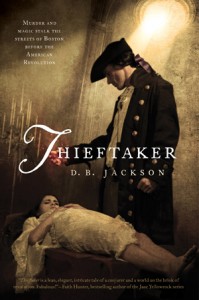
Thieftaker by D.B. JacksonWriters often draw upon history, be it for inspiration, for setting, for character, for plot ideas, or for some combination of these. Recently, I have embarked on a new phase in my career, turning from epic fantasy to what I call historical urban fantasy. And even as I borrow so many of my ideas from the past, I find myself wondering what I owe history in return.
I have a Ph.D. in U.S. history, and though I have been a refugee from academia for far longer than I was actually a part of it, I still harbor a certain reverence for the study of our past, and a near-obsessive concern for historical accuracy. I also understand that “accuracy” is a term that is both freighted with unintended meanings and nearly impossible to define for more than one person at any given moment. Still, to the extent possible, I want to get the easily-verified stuff right. I want to put the correct people in the correct place at the correct time.

The first thing I owe to history: attention to detail. This is not to say that I can’t bend some “facts” to my own purposes.

That I believe, is the first thing I owe to history: attention to detail. This is not to say that I can’t bend some “facts” to my own purposes. Authors do that all the time. Indeed, often that is the point of our work, whether it’s giving the Confederacy superior weaponry — as Harry Turtledove famously did in The Guns of the South — or having Charles Lindbergh, an anti-Semite and white supremacist, defeat Franklin Roosevelt in the 1940 Presidential election — as Philip Roth did in The Plot Against America. In my new book, Thieftaker, I portray Boston in 1765 as accurately as possible, with two notable exceptions: First, in my book the city’s population includes some people who are conjurers, and second, the city has at least two thieftakers working within its boundaries. I’ll leave a discussion of magic and conjuring for another day, but I will readily admit that thieftakers did not actually appear in any North American city until the early 19th century and then only for a very brief period.

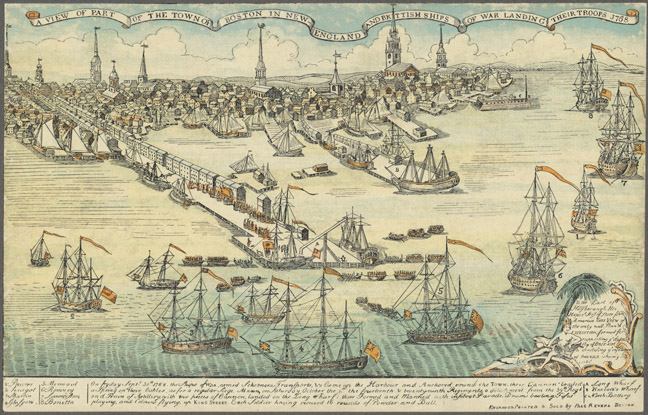
Boston in 1768

Boston, c. 1768

So, one may ask, if we can add thieftakers and conjurers to a city population, or give modern machine guns to the army of the Confederacy, or change the outcome of a Presidential election that occurred over seventy years ago, all in the interests of satisfying our narrative needs, how could it possibly matter what color Samuel Adams’ house was painted? And while I know it’s not a satisfactory answer to the question, I will start by saying “Because it just does.” Read More »