Posts Tagged: Fantasy

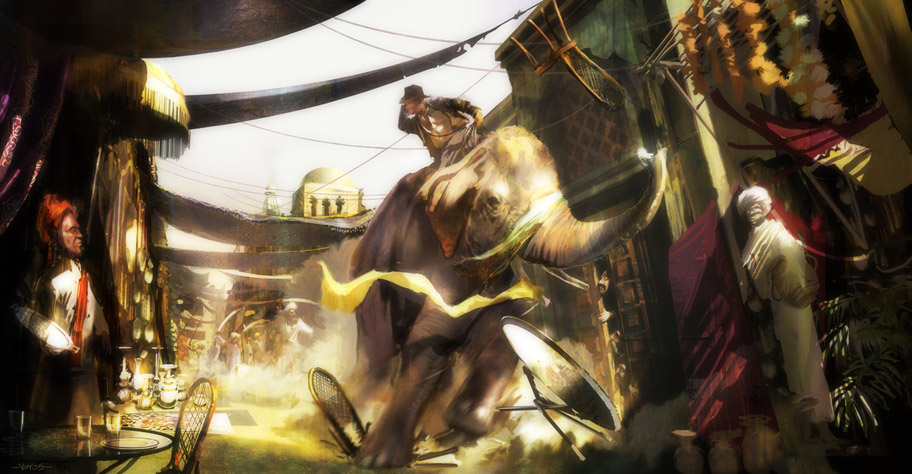
Indiana Jones

I Like a Little Globetrotting with My Action

Let’s talk about modern adventure stories. My generation grew up watching what I consider to be the pinnacle of the modern adventure story: Raiders of the Lost Ark. So when adventure comes to mind, Indiana Jones is the first name on the tip of my tongue. Like any classic film, there are so many standout moments in Raiders, and I it’s difficult to narrow its successes to just one or two. Let’s take a handful.

I remember the massive boulder chasing Indy through the narrow corridor and that somehow cocky look of fear only Harrison Ford can pull off. There’s the bar fight with the read poker and burning alcohol, the bad dates and the dead monkey, that guy with the big sword who Indy guns down as he catches his breath. Then there’s the snakes (“Why did it have to be snakes”), the fist fight and bloody plane propellers, and of course the opening of the arc which is so face-meltingly magnificent, it literally melts their faces.

Man, Raiders of the Lost Ark is a great film.

But for all the action and glory the modern adventure genre story tacks on, over the years I worry that it has lost something somehow. Adventure is classified by traveling action. One scene is in America, the next is in France, then we’re stealing some gold in Africa, and dodging explosions in Australia. These days, it seems the between Action and Adventure is only the distance put on the odometer during the course of the story. Read More »

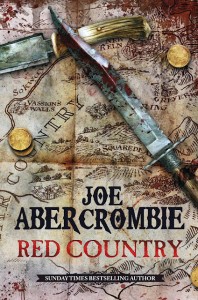
Cover Art for Red Country by Joe Abercrombie (UK)

Map by Dave Senior and Daggers by Didier Graffetaption

Today, Joe Abercrombie, best known for his fantasy trilogy, The First Law, announced his next novel today. It’s called Half a King, it’s unrelated to The First Law and it is aimed ‘partly at younger readers (maybe the 12-16 range).’ Abercrombie explains his decision to leave the world of The First Law and adult fiction behind (albeit temporarily):

[Half a King is] much shorter – 80,000 words compared to 175,000 for my shortest, Red Country, and 230,000 for my longest, Last Argument of Kings (though still over twice the length of The Lion, the Witch and the Wardrobe, believe it or not). It’s set in a very different world with what you might call a viking or anglo-saxon feel. It’s much more focused, with a single point of view. It’s not so overtly ‘gritty’ although it’s a long way from smooth.

[…]

I’ve published six hefty adult fantasy books in seven years. Although I’ve tried to make them all different in some ways – different structures, different settings, different points of view – they’re all pretty beefy, they’re all set in the same world, they have a similar tone, they cover some of the same ground. Though I’m very happy with and proud of the result, Red Country was a difficult book to write. I felt at times somewhat uninspired. Somewhat burned out. I really didn’t want, as I had every time in the past, to go straight on to working on the next book in the First Law world right after finishing one. I felt the need to step back, recharge the batteries, try something at least a little bit different. But at the same time I didn’t want the acorn to fall too far from the tree – I wanted it to be something that my established readers would enjoy, or perhaps even love with a flaming passion. I wanted to set up two separate lines of work that would complement each other creatively and commercially.

More than any other contemporary author, Abercrombie is known for injecting life (and, perhaps it could be argued, popularizing entirely) the fantasy’s popular movement towards ‘grimdark’ storytelling (don’t know what that it? Let Elizabeth Bear tell you), so it’s unusual (but, if you ask this guy, refreshing) to see him step away from that completely for his next series.

As much as I enjoy Abercrombie, I can only take so much of his trademark droll dialogue, self-destructive characters (despite my love for them!) and frenetic violence before I feel like the world’s about to fall out from under my feet. Abercrombie describes Half a King as ‘punchy’ rather than ‘gritty,’ and he hopes ‘to deliver a slap in the face with every page.’ The biggest issue with some of his recent books is their tendency to feel like the author was trying to ‘out-Abercrombie’ himself, to up the ante beyond what he’d done previously. So, I’m looking forward to this change of pace. It sounds like just the thing to re-energize the (self-described) burned out author.

Abercrombie’s future plans? To finish this trilogy, and then begin working on a new adult trilogy set in The First Law universe:

My plan now is that the two sequels, cautiously titled Half the World and Half a War, will be my main focus for the next year or so. I’m already a few chapters into the first draft of the second book. I hope to have those two books finished not long after the publication of Half a King in July 2014. Then I’ll start work on the adult trilogy in the First Law world. So that’s me kept pretty busy ’til … at least winter 2017, I’d say. Which is both rather nice and rather horrifying.

Half a King will be published by HarperCollins in July, 2014. The sequels, Half the World and Half a War, will follow at six-month intervals. It’s interesting to note that Abercrombie has sold more than three million books to date. That’s a hell of a lot.
The Stories: Five Years of Original Fiction on Tor.comTor.com is celebrating its fifth birthday. As part of this celebration, my old haunt has compiled an eBook anthology of all the short stories published on Tor.com during that period. It’s called The Stories: Five Years of Original Fiction on Tor.com and it contains 151 stories from many of today’s best writers of science fiction and fantasy, including Nnedi Okorafor, Rachel Swirsky, Daniel Abraham, and Jay Lake.

Tor.com describes the celebration:

Tor.com is celebrating its fifth birthday this week and as one of the many things we’re doing to mark the occasion, we’ve assembled the entire last five years of our award-winning original fiction into one handy, and possibly physics-defying, ebook.

This ebook is free to Tor.com’s registered users to download, as a thank you for joining and contributing to our community over the years. Enjoy!

To download the eBook DRM-free (.epub, .mobi, .pdf), login to Tor.com (yeah, you’ll need an account, sorry…), and visit the blog post about The Stories: Five Years of Original Fiction on Tor.com. If you don’t have an eReader, you can also find the stories here, published directly on Tor.com You won’t find a better anthology published all year. Sorry, Unfettered.

When We Were Executioners by J. M. Mcdermott
If, if, if.

Money problems that are public are like a social media alert button, like Google alerts, a magic wand that summons author attention to even the most obscure rumor mills of the internet.

There’s a kind of creeping horror that strikes the heart of an author when they discover the company with whom they have two novels out is slowly collapsing into a shambling mound, devourer of careers and eater of all working energy. Let’s be clear: Jason and Jeremy are not the subject of what I am discussing. There comes a point where people just sort of don’t make a difference much, because what matters is that the company is collapsing and it wouldn’t matter who was running the broken space ship into the wormhole. It’s sort of like working at any company that’s failing. It’s easy to play armchair quarterback and wonder at the decisions made. But, deep in the muck of collapse, what is it like?

Publishing isn’t the sort of gig that you go to work and go home and vent with your spouse about your day. It’s not like that at all. I work out of my house, and will have fewer than a dozen emails about a project in a year, unless there’s some serious marketing and promotion campaign happening, and then maybe two phone calls total. It’s not like there’s much water cooler chatter, most of the time. Most discussion channels are public. I can’t tweet about that rising uneasy feeling. I can only watch as news comes over the transom. Money problems, which are private, are sort of a low hum in the background of your mind. Money problems that are public are like a social media alert button, like Google alerts, a magic wand that summons author attention to even the most obscure rumor mills of the internet. Read More »

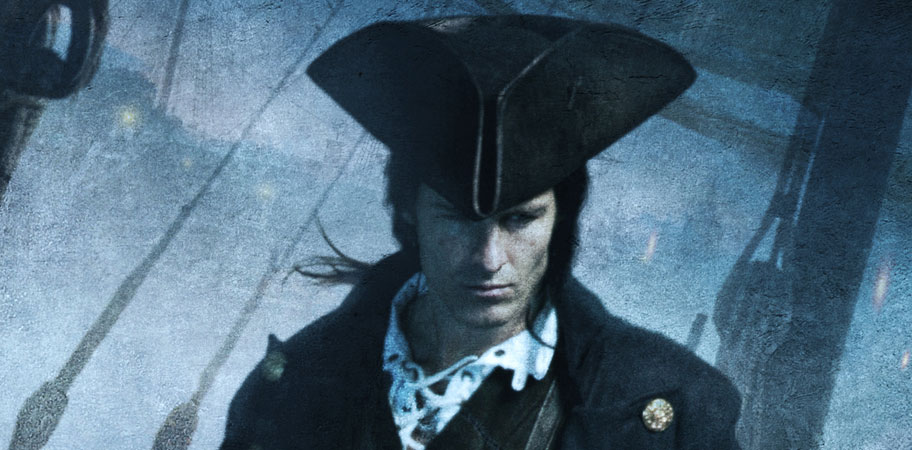
Thieves Quarry by D.B. Jackson
Ideology, Politics, and the Writer

This is a post about writing; it is not a post about politics.

This is a post about writing; it is not a post about politics. I want to make that clear from the outset. I am not trying to write a polemical piece, nor am I looking for a fight. Please, let’s try to keep comments and discussion to the writing issues.

My first series, the LonTobyn Chronicle (which I wrote as David B. Coe), was a fairly straightforward epic fantasy trilogy. But I originally conceived of it as something I called “an ecological fantasy,” because it played on ecological issues. I didn’t worry about putting off readers; in my callow arrogance I just figured that those who were interested in the issues would see what I was doing, and those who didn’t would still enjoy the story. The problem was, I used too heavy a hand in weaving those issues into my narrative. In its review of the final volume of the trilogy, Publisher’s Weekly noted this, saying, “Characterization, although present, plays second fiddle to ideology in this epic. It’s as if Robert Jordan began channeling Will and Ariel Durant.” Read More »