Posts Tagged: Orbit Books

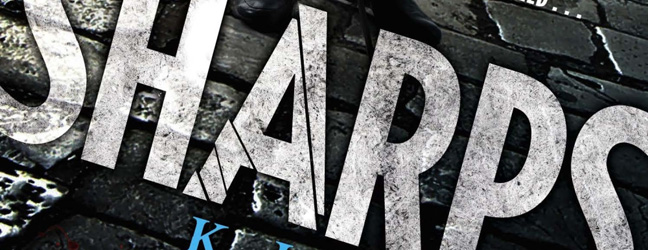
Sharps by K.J. Parker

I was at the bookstore yesterday and noticed a copy of Sharps sitting there, hidden away between several other books. I didn’t realize it was out, my wife was still busy elsewhere in the bookstore and some of my friends have recently raved about Parker’s work, and Sharps in particular. So, I picked it up and started leafing through it. What’s the harm, right? It goes without saying that I really enjoyed the small bit of the book I browsed through, otherwise I wouldn’t be writing this post.

Synopsis

For the first time in nearly forty years, an uneasy truce has been called between two neighbouring kingdoms. The war has been long and brutal, fought over the usual things: resources, land, money…

Now, there is a chance for peace. Diplomatic talks have begun and with them, the games. Two teams of fencers represent their nations at this pivotal moment.

When the future of the world lies balanced on the point of a rapier, one misstep could mean ruin for all. Human nature being what it is, does peace really have a chance?

Reviews

Jared Shurin, Pornokitsch:

Sharps is, for lack of a more poetic way to put it, the first commercial KJ Parker novel. The one where the elevator pitch – swords, sports and diplomacy – is just as appealing as the text itself. And you know what? It is marvellous. Sharps not only has all the wit and complexity of Parker’s other work but also hearty doses of glory, romance and adventure.

[…]

Sharps also appeals through its surprisingly epic scope. Although a long way from writing a ‘chosen one’ narrative, the book has a more familiar fantasy structure than Parker’s other work: five reluctant heroes are off to save the world. Parker has repeatedly written about the impact of small people on great powers, but, in the past, the focus has been entirely on the individual. The Engineer Trilogy, for example, is about one man’s plot to change the face of the world. But the face of the world is incidental: all he wants is to go home. The Folding Knife is similar – a man sets out to forge an empire, but all he really desires is the love of his family.

[…]

With all the flying steel of Sharps, a bit of swash and buckle is inevitable, yet Parker stays on message: life and death, politics and war – all riveting stuff, but they’re never games. And for those that persist in taking these things lightly: Here they fight with messers. God help them.

Packed with sharp edges and provocative points, Sharps may be the book that fantasy readers have been waiting for. Not necessarily for Sharps qua Sharps (although it is undeniably great) but because its crowd-pleasing premise should serve as the long-awaited gateway drug to Parker’s entire world.
Read More »

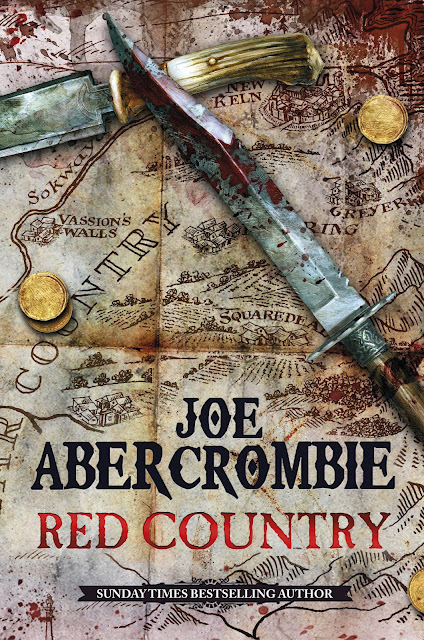
Cover Art for Red Country by Joe Abercrombie (UK)

Map by Dave Senior and Daggers by Didier Graffetaption

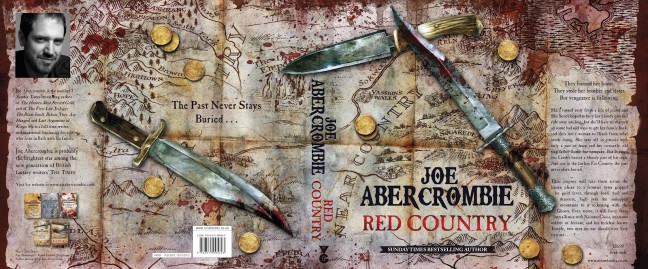
Yep, that’s an Abercrombie cover. Yep, still awesome. There’s also a full spread and a finalized synopsis:

Red Country by Joe Abercrombie

They burned her home.

They stole her brother and sister.

But vengeance is following.

Shy South hoped to bury her bloody past and ride away smiling, but she’ll have to sharpen up some bad old ways to get her family back, and she’s not a woman to flinch from what needs doing. She sets off in pursuit with only a pair of oxen and her cowardly old stepfather Lamb for company. But it turns out Lamb’s buried a bloody past of his own, and out in the lawless Far Country, the past never stays buried.

Their journey will take them across the barren plains to a frontier town gripped by gold fever, through feud, duel and massacre, high into the unmapped mountains to a reckoning with the Ghosts. Even worse, it will force them into alliance with Nicomo Cosca, infamous soldier of fortune, and his feckless lawyer Temple, two men no one should ever have to trust…

I’d’ve liked to have seen a different palette, since this one treds so closely to what we saw with Best Served Cold and The Heroes, but that’s really my only complaint. Great stuff, better than the US cover. A few weeks ago, I gathered together everything we know about Red Country, check it out, if you’re interested.

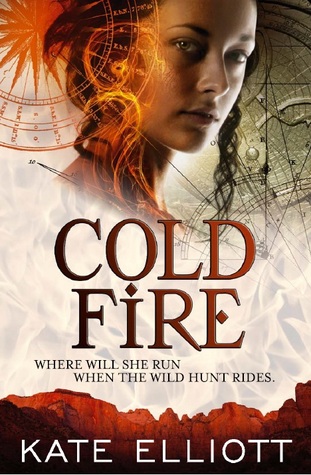
Cold Fire by Kate ElliottI wanted to write a post about diversity.

It could open something like this: In a diverse world, is fantasy and science fiction literature open to the largest possible view of the world and its cultures? If not, why not? What am I as writer, as reader, and as viewer doing to promote and highlight a more realistic view of the world’s diversity?

But such an opening already presupposes that I’m writing from the stance of a cultural hegemony centering around Euro/American settings and its structural, political, historical, and religious backdrops. The phrase “a more realistic view” already situates me within a US-centric sphere. It begs the question: More realistic than what?

The instant I say “diversity” what I mean, whether I want to or not, is that I’m writing to an audience in which the default mode lies in being male, white, and mostly straight. Or, to quote writer Aliette de Bodard, the [phrase] “‘importance of diversity’ boils down to ‘why white people benefit from seeing POCs in fiction.’”

POC, for those of you who may not know this acronym, in this instance stands for ‘people of color.’ I agree with Bodard, and I want to add that for the purposes of this post, I’m speaking of diversity in its largest sense, to include gender, gender identity, ethnicity, race, religion, nationality, language, class, and so on.

I’m weary of having this conversation over and over again. Read More »

Cover Art for The Blinding Knife by Brent Weeks

Gorgeous. Like, really gorgeous. And a step up even from the impressive early version that leaked a few weeks ago. I say this despite the hooded figure on the cover, which is saying something. It’ll look even more sharp if they end up using the foil-stamp technique that we saw on the paperback edition of The Black Prism. Good job to Lauren Panepinto, artists Shirley Green, Silas Manhood, and the Orbit Books crew.

The Troupe by Robert Jackson BennettThere was a moment the other day when I saw a famous author on twitter point out to everyone that they were not their characters. “If I was,” they said, “we’d all be in danger.” This was a joke, of course – the suggestion was that since a fair share of their characters were murderers or psychotics, then the author could not be them, as the author is not, to the best of anyone’s knowledge, a murderer or a psychotic.

This joke highlights one of the fun, fuzzy, gray areas in writing relationships – where do characters come from? How do writers make them up? Or do they make them up at all?

Characters aren’t precisely “made up,” I don’t think. When we think of fictional characters, we imagine them as just sort of popping into space – they do not exist, and then the writer thinks of them, and suddenly they’re there. Something from nothing, in essence.

But it’s not from nothing. People think writers work with no raw material at all, but they actually do – they work with themselves.

Imagine a writer as a huge, swirling, dripping ball of knowledge, memory, and experience. The ball is so big it’s impossible to hold in your hands, or even to get your arms around – after all, we’re talking about years and years of conscious and subconscious impressions, connotations, associations, all kinds of messy intangibles. And you can’t funnel that into any one character – the ball is just too big and unwieldy for anyone to make a copy of it.

So what does a writer do? They pull off a chunk, like a piece of clay. Then they take that chunk and massage it, and maybe add more chunks from the main ball if they think it’s necessary, and they sculpt it and shape it and adjust it until it has the semblance of a real person – the sculpted chunk’s got emotions, experience, agency, prejudices, goals, all that kind of fun crap.
Read More »